

Who’s Afraid of Freya India?
The fight for the future of women

“Since she logged off from social media for good in 2021, 26-year-old Freya India has amassed the sort of reach most influencers can only dream of.”
That’s how The Times of London describes the author Freya India in an interview about her new book, Girls®.
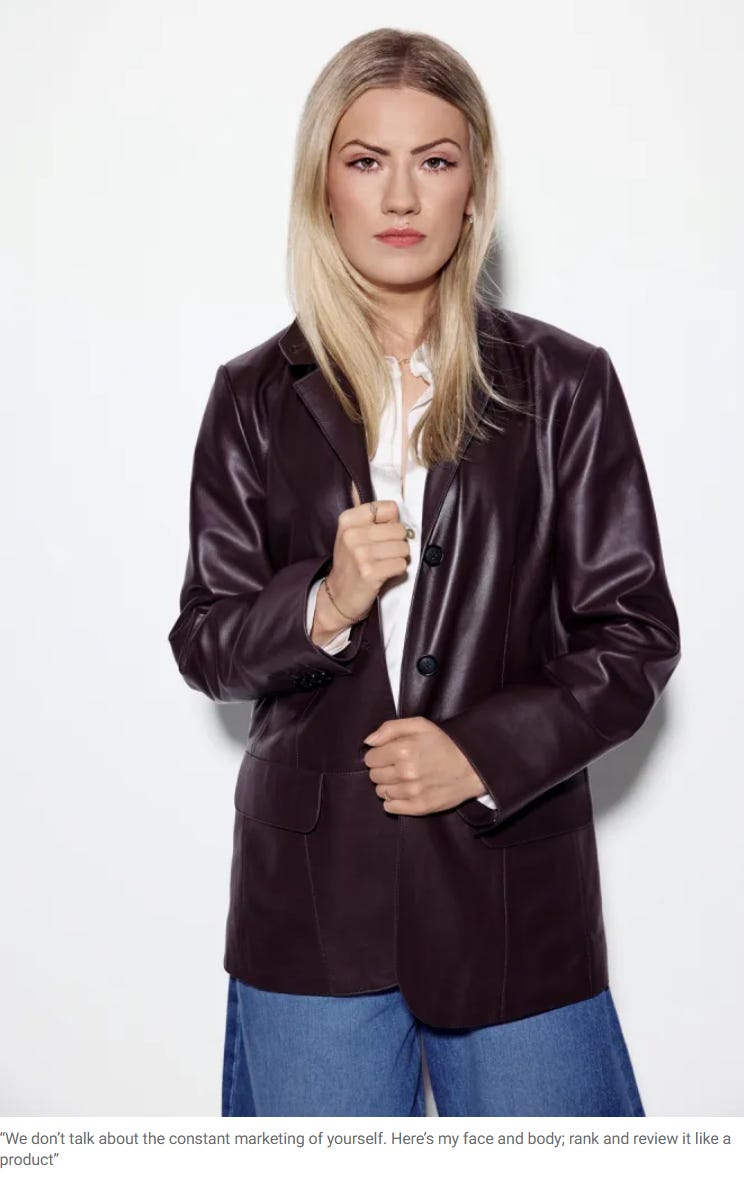
It’s a clever bit of framing: it sets India up as a victor over her fellow influencers, and the photo to cap the paragraph has India modeling in designer clothes with a caption, “We don’t talk about the constant marketing of yourself. Here’s my face and body; rank and review it like a product.” In the space of three grafs, the reader is made to understand that India is a climber, a hypocrite, and is brazen to boot. She is not a serious person.
I’ve followed India since she began writing on Jonathan Haidt’s Substack After Babel about the plight of Gen Z girls. If Haidt offers the statistics about how girls, particularly liberal girls, are struggling, India delivers the firsthand stories. She has a knack for naming the strangeness of life online and the empathy to explain how Gen Z ended up so materially comfortable yet psychologically maladjusted.
Her popular Substack “Girls” has over 50,000 subscribers, and she earns praise from diverse quarters of the commentariat, including Derek Thompson, Jon Haidt, Bari Weiss, and Rusty Reno. For a time, she seemed capable of no wrong.
But that time has passed.
Now that she’s reached a certain level of success, she’s become a target for take-downs from all sides. Leftist critics calls her a “trojan horse” for alt-right conspiracies, a “pick me” desperate for male approval, and a conservative Christian lecturing her secular peers. From the opposite side, she’s called a liberal feminist for “pathologising male heterosexuality” and ignoring the problems facing men today.
I got lunch with her last week and found the person described in the press far different than the one sitting across from me. India is a charming, self-deprecating Brit, and far from an attention-seeking wannabe influencer, she is very cautious to not appear too ambitious. In America, striving to build a public profile is celebrated, but in Britain, people are told to stay in their place.
So despite her success, India remains modest, and Girls® reflects that intellectual restraint.
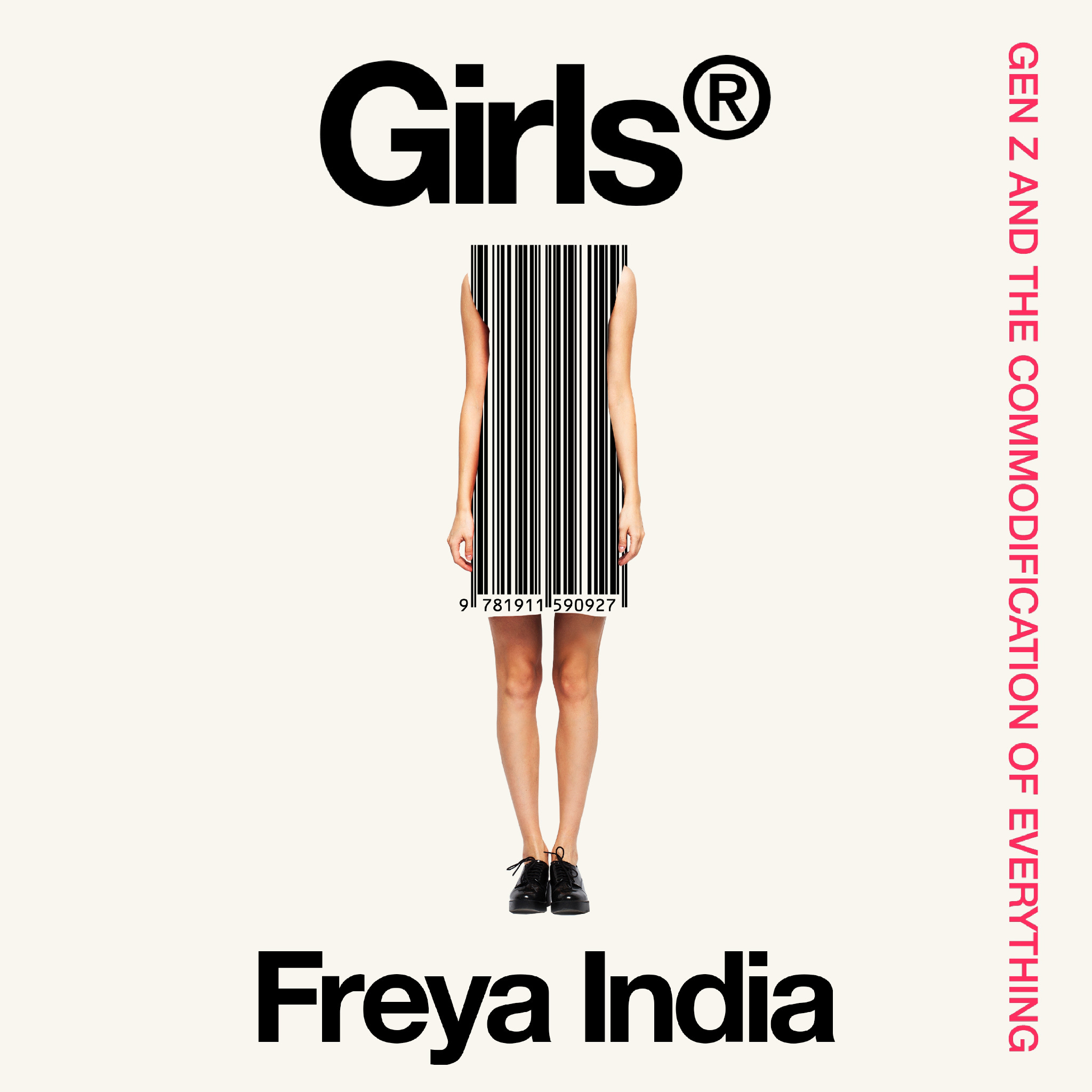
In the introduction, India clarifies what Girls® is not. It’s not meant to speak for all Gen Z girls. It’s not meant to be an exhaustive list. It’s not meant to put girls’ struggles above boys’ struggles. She writes that she focuses on girls because it’s the one topic where “I feel I can speak with what little authority I have. I am not an expert or an academic. I am a woman in her twenties.”
The book makes no policy recommendations and few prescriptions of any kind. Instead, it walks through six chapters on different areas of life where girls are struggling: Filtered (appearance), Diagnosed (mental health), Documented (posting their lives), Disconnected (friendship), Detached (relationships), “Empowered” (career). She gives her thesis right up front: “Modern digital technology amplifies the age-old anxieties adolescent girls have always felt.”
For instance, India admits women have always cared about their appearance and felt self-conscious through puberty. But through social media and body filters like Facetune, they are now acutely aware of the gap between their real body and their idealized body. When they come in for cosmetic surgery, instead of bringing a photo of a celebrity, they bring a printout of their Facetune.
But in her typically gracious way, India doesn’t condemn these women. She just says this sort of commodification is what they were trained to do. Even OnlyFans is really just a continuation of the behavior begun when a 12-year-old posts a sexualized selfie.
If that sounds hysterical or off-base, consider that Shannon Elizabeth of American Pie recently justified joining OnlyFans by saying she wants to be closer to her fans: “OnlyFans gives me the opportunity to offer something more—a behind-the-scenes, unfiltered look at my life and a genuine connection that no other platform allows.” The same logic as Instagram just carried to its extreme.

India felt the story of digital harms had been told by Jonathan Haidt and others, but there was a gap for a firsthand narrative. She tells me, “it was all charts and graphs and I don’t think that’s as compelling as maybe having both, which is the statistics, but also the emotional story.”
Girls® isn’t meant to replace Haidt’s The Anxious Generation. It rounds it out.
India’s approach necessarily opens her up to a certain amount of criticism. She’s not arguing as a brain on a stick but very much as an embodied young woman trying to explain the psychic distress of growing up online. Her age, gender, and biography are inextricably bound up with her writing.
Even so, the scrutiny she receives seems more varied and spirited than you might expect. There are three primary lines of attack.
India as Bimbo
A few weeks back, a popular British writer wrote a 7,000 word Substack article “At War with Freya India,” which included some substantive critiques but was filled with ad hominem and implication. For instance, she points out that one of India’s chapters includes a subheader titled “Consume” and a sentence, “Coming of age with only consumerism as our guide, girls my age had no road map.” From there, she concludes India must have been influenced by the Reddit page r/ConsumeProduct, which was a cesspool of antisemitism and conspiracism. You, wise reader, can connect the dots.
After 6,000 words of that, she writes, “I’d received tipoffs about a managerial boyfriend figure.” (Tipoffs?) She then proceeds to out India’s now-fiancé, castigating him for being a “pro-growth startup guy” who shamelessly reposts India’s articles and speaking engagements. His “preoccupation with Western female fertility” is revealed when he says that women who postpone family life because of single-minded careerism may end up regretting it.
This personal attack is meant to prove that India is a young, attractive, naive woman who is being used by the far right: “The point of Girls® is to gather mainstream consensus for the hard-right’s ideas about working women, birth rates, and civilisational collapse. And its author is a perfect Trojan horse.”
And India’s either too stupid or too fame-hungry to realize what she’s doing.
India as Schoolmarm
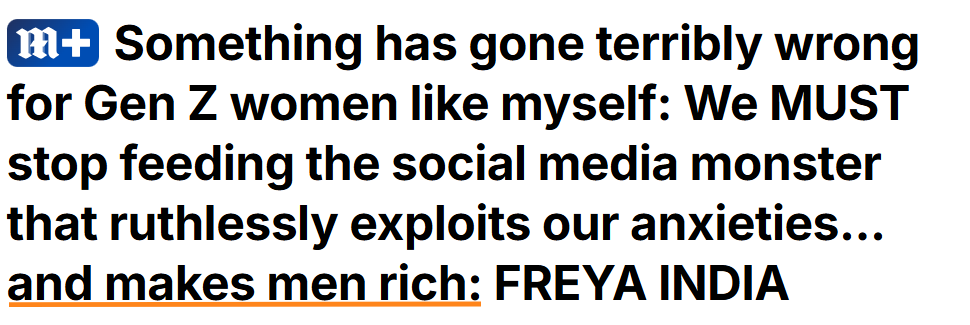
The Daily Mail published an excerpt of her book, and the headline restates India’s thesis with one small addition: “and makes men rich.” And just like that, India’s passage about Kim Kardashian and other female influencers sounds tone-deaf and man-hating:
When writing about relationships, India often comes back to the destruction of pornography. If you’ve watched hardcore pornography before you’ve had your first kiss, that will inevitably damage your ability to form healthy, lasting relationships. She struggled to arrive at that position from her secular upbringing.
If a woman merely says, “my boyfriend watching porn makes me feel bad,” she will inevitably be told, “That sounds like a ‘you problem.’” Only after hearing from countless other women did she conclude that her disgust with pornography was not a personal shortcoming.
In her recent interview for the European Conservative, she spoke about this with Jonathon Van Maren who wrote:
Many right-wing influencers have taken to arguing online that modern women have unrealistically high standards. The reality is that women and girls struggle to find men that meet one very basic standard: He does not look at pornography online and will not cheat on them by watching porn. Many women accept this. As India points out, a key problem in the dating culture today is that many young women have standards that are too low rather than too high.
When Van Maren posted that excerpt on X, his comments were flooded with outrage that this liberal feminist was “pathologising male sexuality.” To be clear, India tells me her point was that women tend to have low standards on moral character and then unreasonably high standards on height, income, political views, etc. She was merely advocating for high moral standards for both men and women.
But even so, the response Van Maren got—the defense of porn platforms and how “normal” watching porn is—made India think these men (with a few women as well) were responding to the guilt they felt more than anything.
To paraphrase her fellow countryman, the anons doth protest too much, methinks.
India as Conservative Christian
Unlike other popular female writers such as Louise Perry or Mary Harrington, India’s book doesn’t give much away with the title. If you pick up The Case Against the Sexual Revolution or even Feminism Against Progress, you have an idea of what you’re getting. India says Girls® is causing “jump scares” in some readers who are expecting an anticapitalist, anti-patriarchy book and are instead finding…something else.
If there is a political influence, Patrick Deneen’s Why Liberalism Failed is the one that stuck out to me. When I ask her about it, India tells me she “really enjoyed” that book because it treated where we’d ended up as a culmination of prior trends rather than some deviation from our intended course. Deneen argued that liberalism’s emphasis on emancipation from social obligations combined with its free market economics led to the commodification of our societal breakdown.
But India follows Deneen only as far as Why Liberalism Failed, a book that drew praise from localists, postliberals, and even President Obama. India doesn’t follow Deneen on to Regime Change, telling me, “I don’t really talk about policy because I don’t know much about it or the consequences.” She says she likes the idea of age verification for porn sites for instance, but she also fears a government database of IDs and the potential for surveillance.
Here again, like a good Brit, she stays in her lane.
As far as Christianity, while India spoke with Justin Brierly about how Christianity seems to offer answers for a lost, hopeless generation of young people, she’s not Jesus-maxxing either. She mentions in passing how her friend N.S. Lyons is an Orthodox Christian who offered her some counsel, but she is not posting her baptism set to worship music.
In fact, India hardly ever posts a photo of herself, a tweet about her life, and she’s never done a direct-to-camera video. That reticence about turning her life into content keeps her relatively private about her religious exploration.
For now, she’ll point to the inadequacies of therapy-speak as a substitute for God, but you won’t catch her endorsing the new Archbishop of Canterbury or the Pope. You might take issue with that for being namby-pamby, but it seems to be the same tack Ross Douthat took with his book Believe.
Rather than making an explicit case for Christianity, he made a case for religion to the agnostic and the skeptic. He may not have led the reader through the sinner’s prayer, but he also will attract readers who wouldn’t be caught dead reading The Case for Christ.
Likewise, Girls will “jump scare” some readers expecting a boilerplate anticapitalist, anti-patriarchy book, and that may prove a first step toward a better future for girls all around. India says she’s “hopeful and optimistic about culture actually changing.” She thinks Haidt and others have shifted the Overton window. The children born today have parents much more aware of the relative dangers of life online versus life offline.
Nevertheless, she fears that conversation around the problems facing young girls will be cut off. If India—who I would describe as relatively tame, highly empathetic, and a young woman herself—can be dismissed as too political or demographically disqualified, then who can talk about these issues? Her reception and reputation is a proxy war for the bounds of acceptable discourse.
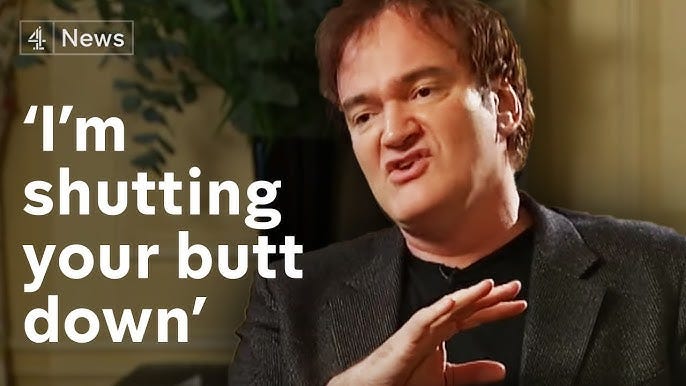
She may well have to go full Quentin Tarantino before too long.
.jpg)
While her work draws a fair amount of praise and some hostility, it’s not uncommon for India to be met with genuine confusion. How can women be so miserable when they are such professional successes? Aren’t they winning in modern society? To this, she replies:
[Women have] everything that we want and nothing we actually need. And so I don’t think the material successes that women have achieved will make them happy. I would say the same for men, which is that our deep human needs: belonging, to feel like we’re part of something bigger and part of community, and that we can love and accept love from people. All these things that, as you say, they’re matters of the heart, I feel like young women don’t have that and young men don’t have that either.
This is classic India. Instead of reaching for St. Paul (if I have not love, I have nothing) or for Robert Putnam (Bowling Alone saw this coming 25 years ago!), she lets it stay in the moment, in first person, in the pain without reaching for a pat answer.
So you can call her emotional for speaking to the heart and speaking from her own experience. You can call her unfocused for publishing a nonfiction book that’s graph-free, neuroscience-lite, and policy-agnostic. You can call her a pick-me, a trojan horse, a misogynist, a man-hater, a teen messiah or any other slur you like (though that may say more about you than her).
Just don’t call her ambitious. Brits hate that sort of thing.
If you liked this, please comment, share, or subscribe! Cheers!
I've never heard of this young woman, but this write-up intrigues me, and I'll have to check out her book. I love seeing people from non-Christian backgrounds arguing against porn use. You're right - the anons doth protest too much. And if saying "this behavior is wrong" is "pathologizing male sexuality" then...I don't know, maybe that needs to be pathologized.
This was lovely. She deserves everything said here. India is an incredible voice for the current and coming generations and maybe she should be feared and loathed by the loathsome because she will assist in turning the tide for the better.