

“The Real Soul Mate is the One You Are Actually Married To”
The Notebook, Taylor Swift, and Tolkien

How many relationships did The Notebook end?
We know of at least one because it was a friend of Ryan Gosling’s. The friend took his fiancée to see The Notebook, and when they walked out of the theater, she said: “You wouldn’t build a house for me, would you?”
Just as a refresher, this is a movie where Noah (Ryan Gosling) writes 365 letters to a girl he barely knows and then builds a house for her and pretends they share it. As Gosling put it at the time, “In any other movie, this guy’s going to get locked up, but she thinks it’s romantic.”
Well apparently the fiancée thought so too, and she wanted to know whether her soon-to-be husband would build a house for her. In Gosling’s telling, the friend replied:
“No, but I can’t. I don’t know how.”
“It’s over.”
“Are you crazy? You’re breaking up with me because I wouldn’t build a house?”
“You wouldn’t even learn to build a house for me?”
“No, but that doesn’t mean I don’t love you.”
“It’s over.”
The first reported casualty.

It’s summertime, and wedding season is in full swing for friends and celebrities alike. Zendaya and Tom Holland were secretly married, Dua Lipa and Callum Turner were just married, and Taylor Swift and Travis Kelce are about to be married. It’s hard to know what impact this high status-marriage will have on rank-and-file romance, but I am reminded of something Ross Douthat wrote last year about life in the digital age: “the celebrity influencer half a world away takes the place in your mental space that friends and neighbors used to occupy.”
In the case of your friends and neighbors, you are able to see them when they are irritable or bored or strange, but through no fault of their own, celebrities are almost incapable of presenting a real relationship.
This is due to what I call the “Dirty Corners Paradox.”
When I was in college, a friend complained to me one day about how everyone’s Instagram is so fake. They post their vacation pics and their perfectly composed dinner plates and their beautiful white countertops. He wanted to inject some reality to the platform, so he said he was going to photograph the dirty corners of his house. He was going to present his life unfiltered.
While I admire his chutzpah, the trouble with this noble aspiration is that no one wants to see the genuinely dirty corners of your life. And you don’t want people to see them either. Instead, you’ll still want to choose something that is “honest” while still being funny or relatable or representative. You will have revealed something more personal, but you will be engaged in the same activity as the vacation poster. In trying to pull back the curtain, you will only have taken the performance one layer deeper.
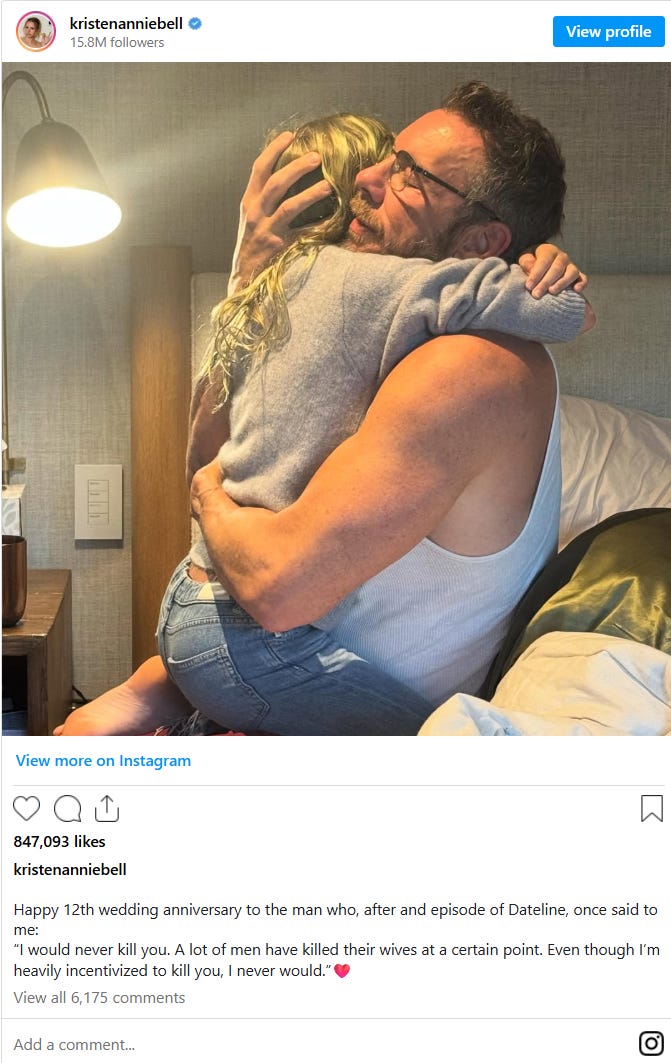
It’s basically the difference between Travis Kelce saying he and Taylor Swift have “never once” argued and Kristen Bell posting: “Happy 12th wedding anniversary to the man who, after an episode of Dateline, once said to me: ‘I would never kill you. A lot of men have killed their wives at a certain point. Even though I’m heavily incentivized to kill you, I never would.’❤️”
While it feels like we are being let in on Kristen Bell and Dax Shepard’s life, we’re still seeing something that is calibrated to endear them to us. It is a dirty corner in name only.
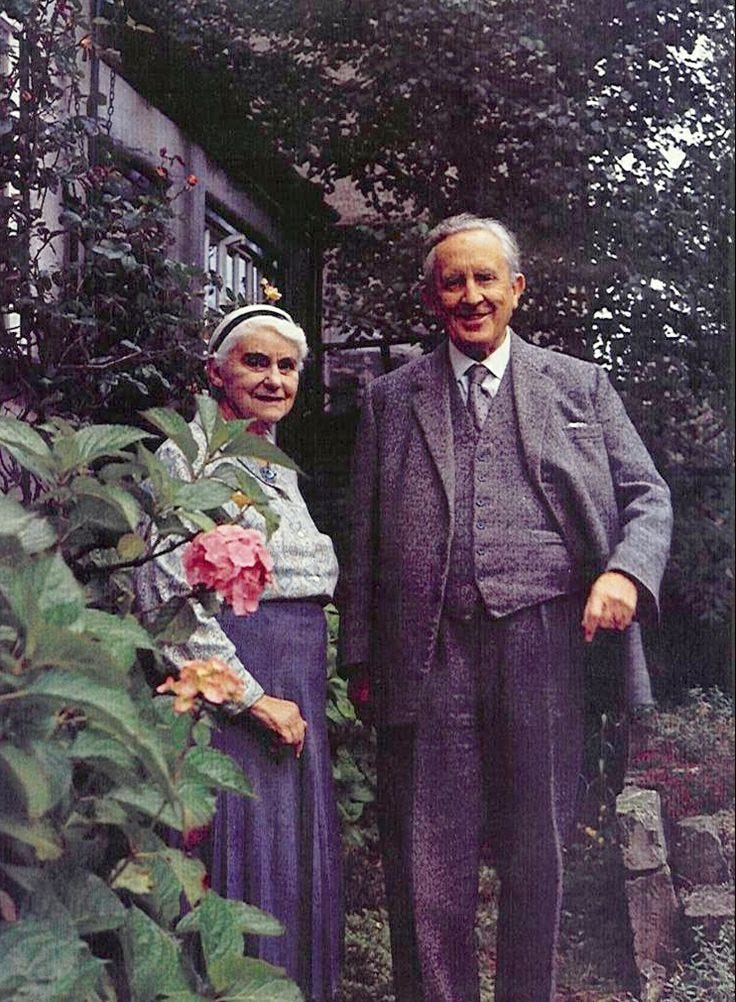
This contrast was brought home when I recently read a letter JRR Tolkien wrote his son Michael. Because they shared the mundane parts of life, Tolkien could credibly explain the importance of sacrifice within a marriage:
[T]he essence of a fallen world is that the best cannot be attained by free enjoyment…but by denial, by suffering. Faithfulness in Christian marriage entails that: great mortification…When the glamour wears off, or merely works a bit thin, they think they have made a mistake, and that the real soul mate is still to find. The real soul-mate too often proves to be the next sexually attractive person that comes along…And of course they are as a rule quite right: they did make a mistake. Only a very wise man at the end of his life could make a sound judgement concerning whom, amongst the total possible chances, he ought most profitably to have married! Nearly all marriages, even happy ones, are mistakes: in the sense that almost certainly (in a more perfect world, or even with a little more care in this very imperfect one) both partners might have found more suitable mates. But the ‘real soul-mate’ is the one you are actually married to.
You may assume this is a case of Tolkien mounting a defense for his loveless marriage, but his own story was quite dramatic. He fell in love at age 18 to a woman who would inspire his story of Beren and Lúthien, a mortal man who fell in love with an immortal elf-maiden. He admits that his “own history is so exceptional, so wrong and imprudent in nearly every point that it makes it difficult to counsel prudence. Yet hard cases make bad law; and exceptional cases are not always good guides for others.”
On the one hand, you could say that this is just a case of an older figure instructing “do as I say not as I do.” On the other hand, Tolkien would know better than most when he speaks of the commitment necessary to sustain a Christian marriage. He had the fairy tale romance as a young man, yet he concludes that the real soul-mate is not the one you find but “the one you are actually married to,” the one you stick with when the glamor “works a bit thin.”
That’s a message that a celebrity is structurally incapable of transmitting. Even if they told you, “Great marriages are built not found,” how could you believe it? They are rich and powerful and had their pick of the litter. If you look at their spouse, could you really believe that, were you in their place, the glamor would ever wear off? And the quiet work of self-denial, even if a celebrity were to undergo it, is something that you cannot post. Outing your spouse’s bad habits or glorifying your own forbearance would ruin the whole thing.
It takes a normal couple to show what a soul-mate really is.
For all of The Notebook’s absurdity—a love story temporarily curing dementia, etc.—it has some solid principles. In a pivotal scene, Noah tells Allie, “It’s not going to be easy, it’s going to be really hard. And we’re going to have to work at this every day, but I want to do that because I want you.”
Even building her the house is a good analogy for marriage. On the face of it, it’s an outrageous act of love and devotion fit only for Hollywood. But on a symbolic level, it’s the sum of a million small efforts for the sake of their relationship with no guarantee of payoff or recognition. Just as a house is this separate thing Noah built, a marriage is something that is somehow separate yet reflective of the couple.
In other words, a “real soul-mate” may not build a house in the literal sense, but he certainly would in the figurative one. So maybe it was a fair question for the fiancée to ask after all. She’s not demanding a wedding at MSG. She just wants to know whether he’s willing to work at this every day, like Noah was.
I don’t know if breaking up was the right thing for them. Maybe their relationship was unsound, and a screening of The Notebook exposed the fault lines. But I can’t help but wonder if he’d spoken to the spirit of her question rather than the literal meaning, if he’d affirmed, “If you’re a bird, then I’m a bird,” rather than protested his lack of carpentry—things might have been different.
Thanks for reading! Feel free to leave any marriage advice you’ve found helpful below, and if you haven’t already, consider joining the team.
The first time I read that Tolkien letter it brought me to tears because of how piercingly human it is. “Out of the darkness of my life, so much frustrated, I present to you the one thing to love…” wow
Oh I loved this! I think you’re so right when you say it takes that normal couple to show us what a soul mate really is. Daily work and dedication! A couple that is married for a lifetime is a wellspring of knowledge! If only we turned to them more than we do our celebrities.