

The Four Types of Young Christians I Know
Saddleback Sam for the 21st Century

Zoomers are the least likely to attend church of any generation. For every 100 people who join the Catholic church, 840 leave (and it’s not much better in other denominations). The only silver lining, if you can call it that, is that the decline of Christianity appears to have leveled off.
At the same time, breathless media coverage presents Orthodox Church pews “overflowing with converts,” a “surprising rebirth” of belief in God, and Christianity suddenly becoming cool.
So which is it?
As is often the case, C.S. Lewis had the explanation back in 1946:
Plenty of evidence can be produced to show that religion is in its last decline among [today’s youth], or that a revival of interest in religion is one of their most noticeable characteristics. And in fact something that may be called “a decline” and something that may be called “a revival” are both going on. It will be perhaps more useful to attempt to understand both than to try our luck at “spotting the winner.”
The reasons for decline and deconstruction among today’s youth have been discussed ad nauseum, so I’d like to focus on the “revival” side of things today. And rather than quoting statistics and running through my graphs, I’d like to tell the stories of four archetypal young Christians today. Here, I am following the example of Pastor Rick Warren with Saddleback Sam:
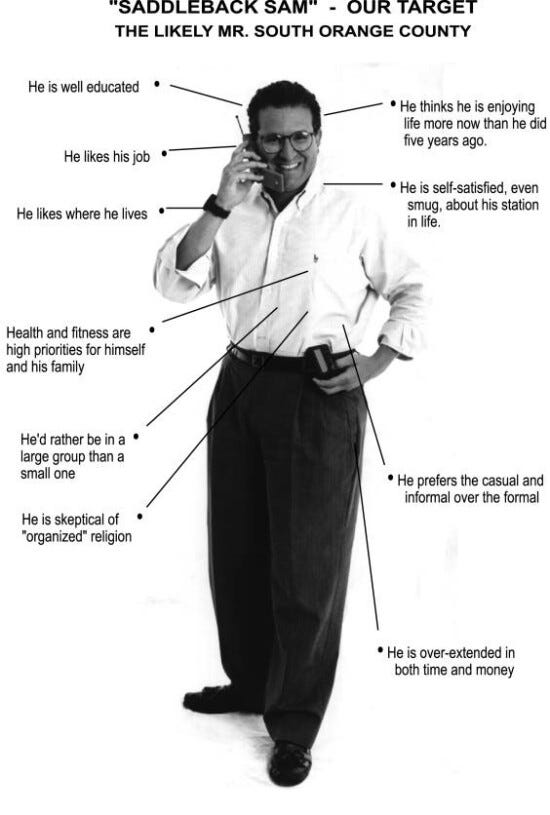
Saddleback Sam was the result of hundreds of conversations Warren had with California locals, trying to understand their motivations for going to church. By distilling his target parishioner into a simple image, Warren was able to focus his initial church planting efforts and tailor his outreach.
While I am not trying to create a church growth guide, the characters I have developed — Double-Down Dave, Community Chris, Well-Researched Richard, and Convert Constantine — were, like Warren, inspired by hundreds of conversations I’ve had with peers and their parents over the years.
I don’t pretend to speak for all people in all places, and I am not attempting to be exhaustive. I am merely offering some personal reflections alongside some tasteful infographics. If this jives with your experience or if there’s a character I’ve missed, please leave a comment below.
Without further ado, I give you “The Four Types of Young Christians I Know”
Double-Down Dave:
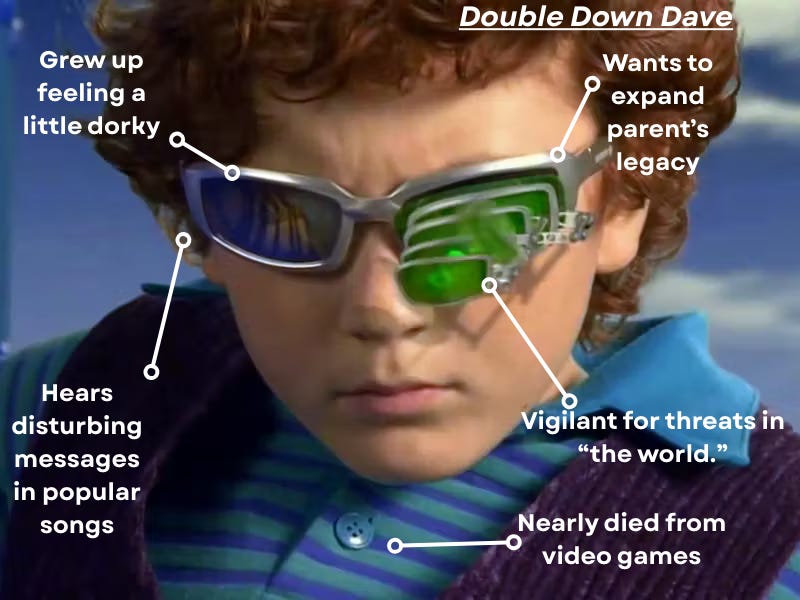
Like Juni Cortez, Double Down Dave is carrying on the family business. Dave was raised in a Christian household and environment, and while he may have strayed away for a time, he now realizes his parents made one mistake: they didn’t go far enough.
When he compares his childhood to the culture his kids will be growing up in, it’s apparent to Dave that everything has gotten worse. His parents were concerned about Harry Potter and Twilight. Now we have Icebreaker and A Court of Thorns and Roses. His parents hated “American Idiot” by Green Day and “Numb” by Linkin Park. Now we have “WAP” by Cardi B and “Juno” by Sabrina Carpenter. He begged permission to watch The Dark Knight and How I Met Your Mother. Now we have Anora and Euphoria.
He may have chafed at his parent’s strictness, but now he realizes they were directionally accurate, just a bit ahead of the curve. Because the cultural output of Dave’s youth still retained some Christian morality. Bella saving herself for marriage is a key plot point of Twilight. Linkin Park was loud, but their lyrics could be a praise-and-worship song: “I want to heal / I want to feel / like I’m close to something real / I want to find something I’ve wanted all along / Somewhere I belong.” Even How I Met Your Mother, despite its many flaws, is centered around someone trying to find a wife and start a family.
By contrast, Dave thinks today’s cultural output revels in its ugliness and perversity. There is no redemptive message lurking below the surface. It is aesthetically and morally nihilistic. To make sense of it all, Dave remembers a quote from Alfred in The Dark Knight: “some men aren’t looking for anything logical, like money. They can’t be bought, bullied, reasoned, or negotiated with. Some men just want to watch the world burn.”
Dave understands that this post-Christian culture is crumbling, and he has accepted that barring a national revival, he and his family will be part of the remnant.
Community Chris:
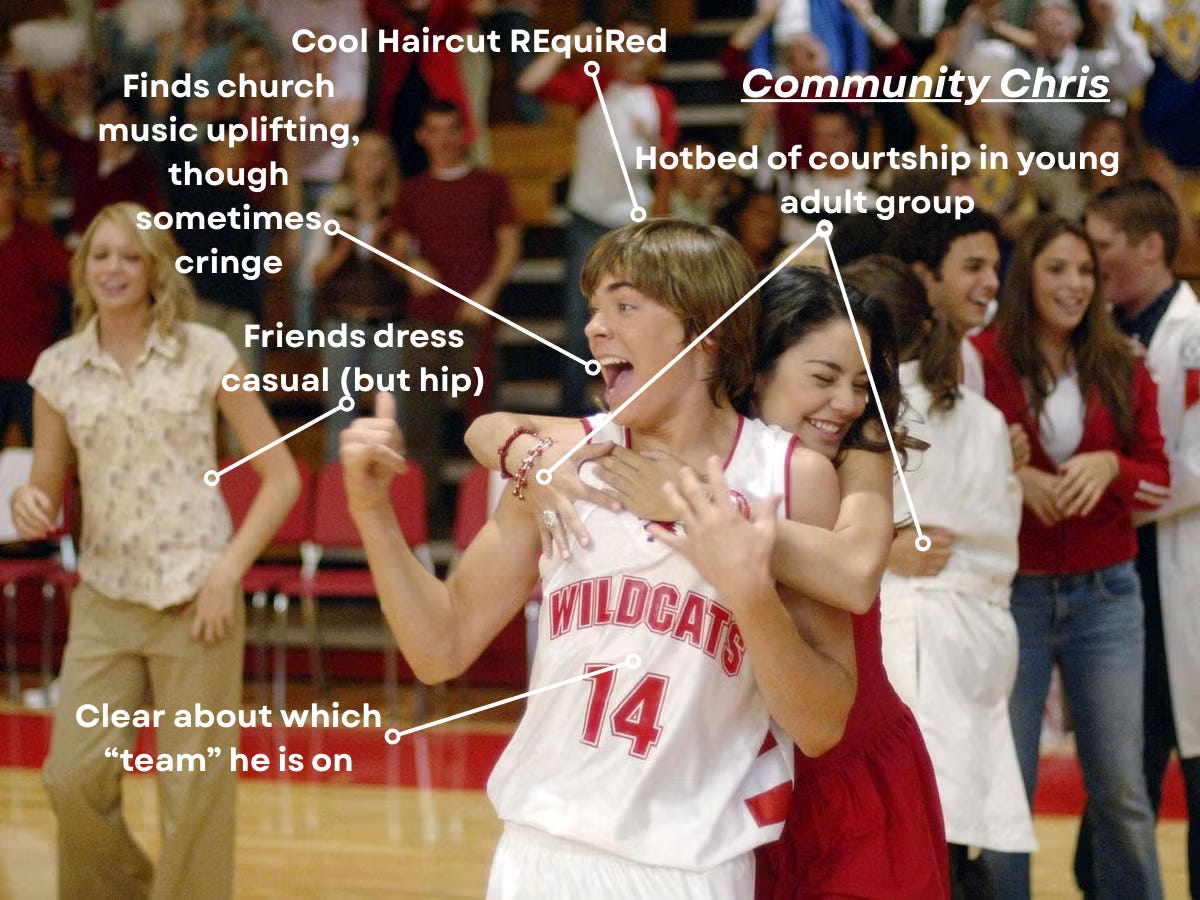
In our anti-social century, we have left behind “bowling alone” in favor of “bed rotting.” Loneliness is now an epidemic. Young people in particular are seeing friends less, having sex less, and are just generally depressed.
If you ask Community Chris about it though, he might give you a puzzled look. He’s in a community group, a men’s group, and a small group. His friend group is a tangle of love triangles and unrequited affection. His calendar is overbooked.
Chris might admit that the substance of his church service is not great (just like Troy from HSM wouldn’t say he loves high school because of chemistry class). But Chris loves his church because he loves the people. He would rather go to a subpar service with his friends than the perfect service without them.
When Chris goes to church, he feels comfortable. These people dress well, they vote for the right candidate, and they have decent, if not impressive, jobs. Chris doesn’t need to cordon off his “church friends” from the majority of his life. His church friends are his life, and he feels comfortable talking about his work, the news, and his weekend plans with them.
He is aware of various critiques of the faith — academic and otherwise — but he doesn’t give them much thought. Not because he’s examined and dispatched them but because they just don’t seem relevant to his life. His friends are all on the same page, so why bother with what some egghead says?
Chris is generally optimistic about his future. He’s got girls, he’s got friends, and he’s got a good job. Alright, alright, alright.
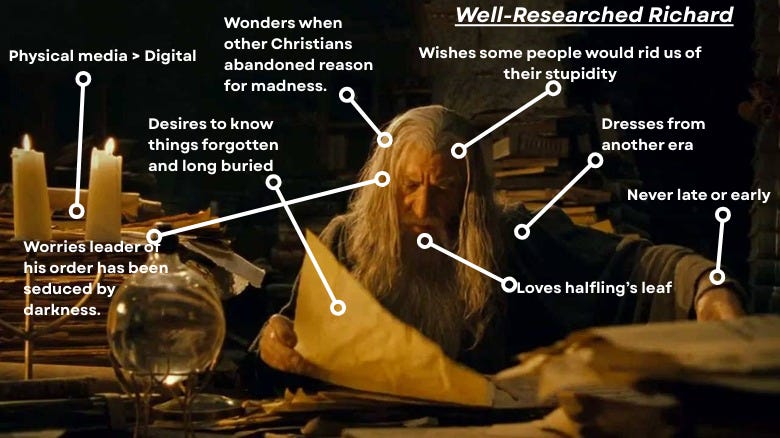
Well-Researched Richard:
When I interviewed Ross Douthat for Believe, he offered a theory for the secularization that accompanied the rise of the internet: apologetic naivete. Suddenly a kid in Naperville was hearing for the first time that the Pentateuch wasn’t written by Moses, that Isaiah wasn’t written by “Isaiah,” and that the gospels are internally inconsistent. This wasn’t new to the Christian intelligentsia, but for a generation of bright-eyed youths, it was devastating.
Thus, the rise of New Atheism wasn’t merely a function of techo-optimism and the impending triumph of science. It was a story of information dissemination made possible by the internet. Even as New Atheism has waned in influence, many young people still retain a vague sense that Christianity has been disproven and that its only contribution to history was war and superstition.
In the face of this ambient disdain, some abandoned the faith, some retreated to platitudes, but some — like Well-Researched Richard — stepped up to the plate.
Richard’s favorite verse is 1 Peter 3:15, “be ready always to give an answer to every man that asketh you a reason of the hope that is in you,” and whether it is an online argument, a family dinner, or a co-worker’s innocent question, Richard is always champing at the bit to explain how he has finally found the Truth.
Richard watches theological debates in his free time as blood sport. It is apparent to him that all other religions and Christian sects are illogical, and thus he can only conclude that these people are either unaware or unconcerned that their house is built on sand. At every opportunity, he tries to turn them from their folly.
He is skeptical of squishes and a keyboard apologist with a hair trigger. Like Gandalf, he feels he is plagued by foolish companions that he must counsel. His “church leadership” is always at risk of compromising their theological rigor and integrity. No matter what church Richard attends, he must maintain a critical distance, always monitoring whether he agrees with what’s being taught. If he doesn’t, they’ll be hearing about it.
Aesthetically, Richard may smoke a pipe or enjoy a fine bourbon, or he may do neither, but he will always seek to comport himself in a way that is slightly more refined, old-fashioned, and well-considered than the hoi polloi.
Convert Constantine:
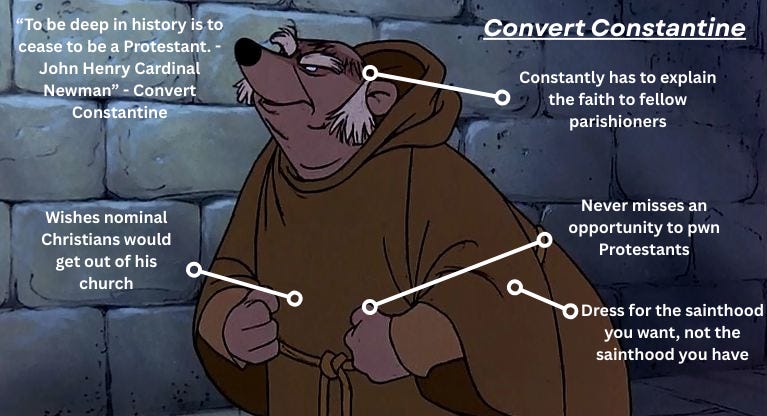
Though the name “Constantine” might imply a Roman Catholic, Convert Constantine could be any young person who is deeply, perhaps unreasonably, proud of their tradition. David Bentley Hart told a story from when his brother went on a tour in Constantinople. As they were riding on the bus, a recent Orthodox convert burst out in a deep Southern drawl, “these Latins simply cannot understand what the sack of Constantinople in 1204 still means to us.”
While this sort of Catholic-on-Orthodox fighting will occur occasionally, Constantine’s most telling trait is his four word motto: Always Dunk On Protestants. This can take many forms. The unrelenting soft pressure campaign: “You’re going to convert. It’s just a matter of time.” The not-so-subtle dig, “Wouldn’t you say Protestantism’s ‘deep history and tradition’ is a bit of a stretch?” The pwn with facts and logic: “If sola scriptura is true, then why couldn’t the Reformers agree on the meaning of communion?”
It’s worth noting that this zeal for tradition is not the same as zeal for church hierarchy. Constantine would see no contradiction between praising the Catholic Church one moment and bashing Pope Leo the next. In fact, criticizing Leo can signal his exceptional piety. But he likes having something to push back against. In an ever-shifting and increasingly virtual world, the stability, physicality, and mysticism of liturgical worship appeal to Constantine.
As he looks around, Constantine feels he is in good company. The best and brightest converts are leaving secularism in favor of the liturgical. Tom Holland (Anglican), Shia LaBeouf (Catholic), Matthew B. Crawford (Anglican), Niall Ferguson (Anglican), Ayaan Hirsi Ali (Anglican), Jordan Castro (Eastern Orthodox), Louise Perry (Anglican), Mary Harrington (Anglican), Dasha Nekrasova (Catholic), Tammy Peterson (Catholic), N.S. Lyons (Eastern Orthodox), and Paul Kingsnorth (Eastern Orthodox).
Now Constantine just has to get the apostates and the Chreasters out of his church à la Friar Tuck, and he should be all set.
In the same essay where Lewis observed a simultaneous decline and revival, he mused on the future of Christianity for Britain. While he admitted that a certain public, cultural Christianity would be lost, he didn’t believe confessional Christianity would necessarily suffer. The secularizing forces would merely force a decision: “When the Round Table is broken every man must follow either Galahad or Mordred: middle things are gone.”
The middle things are gone, the lukewarm Christians have drifted away, and now the church has an opportunity to be a compelling, countercultural witness to the world. All we have to do is deny ourselves, take up our cross, and follow Jesus.
Shouldn’t be too tough…
I was skeptical at first, until I got to "Well Researched Richard." Well done, sir, well done.
Entertaining and insightful! It seems as though our digital era allows us to cultivate and envision whatever type of Christianity-expression we like most. We feed ourselves the content that already supports our way of seeing the world and become further entrenched in the stereotype we’ve selected. So while there’s some diversity, our Christian-types are limited… Hope that raising awareness on this trend will help us all to be less one-track minded in our Christianity!