

Emma Camp and the "Apex Predators" of Hosting
Theater kids know how to put on a show.

“All the world’s a stage, And all the men and women merely players” - Jaques, As You Like It
The journalist Chris Hayes once said that theater kids joining the professional world is “like releasing an apex predator into an ecosystem.” Their empathy, charisma, and self-promotion give them an edge in a society where everyone is clamoring for attention. The New York Times ran a whole piece about how Ted Cruz starred in Oliver! and Ketanji Brown Jackson did improv with Matt Damon when they were at Harvard.
The headline was, “Grown-Up Theater Kids Run the World.”
Over the past three years, I’ve interviewed some accomplished hosts, including Nick Gray on throwing the perfect 2-hour cocktail party, Leah Libresco Sargeant on “building the Benedict Option,” and most recently, I got to talk with Emma Camp about her viral essay, “Loneliness is for Cowards.”
Speaking with Camp really crystallized how theater kids (broadly speaking) are the “apex predators” of hosting. Gray, Sargeant, and Camp all have a background in improv, theater, or debate, and on the one hand, that’s not surprising.
If you hated public speaking or being the center of attention, it would be hard to invite 50 people to your house. But it’s more than that. When Gray was launching his book, so many people told him that COVID interrupted parties they’d hosted for years, like a 4th of July cookout, and they never got restarted.
These events used to be part of the annual rhythm, but now the default is to stay in. It takes a brave host to overcome that inertia, someone who can plan something exciting, carry it off with enthusiasm, and is not afraid of getting called insane, weird, or cringe.
Enter the hero.
“Though this be madness, there is method in’t” - Polonius, Hamlet
Camp says hosting is like “directing a play.”
She pictures the blocking of the stage: “people are gonna sit over here, and I have this big island in my kitchen, they’re gonna be standing by the island, almost like I’m a bartender, and I’m gonna be serving the drinks to them this way, and I wanna have it in this glass…”
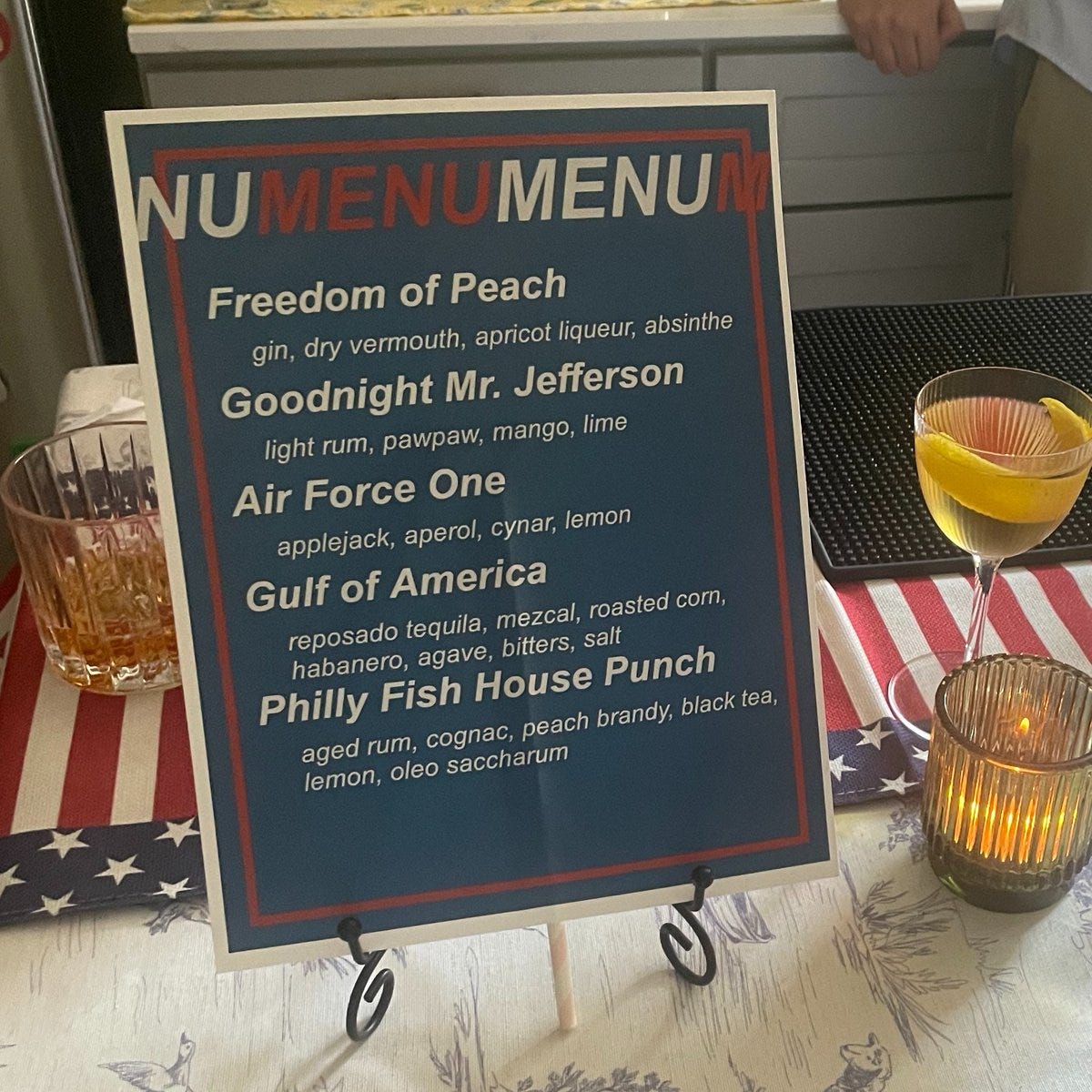
Her preparation is meticulous. For a recent July 4th reading at her NYC apartment, she prepared five different cocktails all themed around the holiday: A Freedom of Peach, Goodnight Mr. Jefferson, Air Force One, Gulf of America, and Philly Fish House Punch.
She sees these as her party’s selling point, her elevator pitch. People want a reason to show up, and she can tell someone new she meets, “I make amazing cocktails. You should come to my house and have them.” And she does not skimp on her craft.
The first ten minutes of our conversation covered everything from how she finally found a use for the pawpaws she’d harvested on Roosevelt Island last summer to how you make a Paper Plane cocktail into an “Air Force One” (swap the bourbon for “the very American spirit of apple brandy”). She concluded: “And then I clarified my lime and lemon juice [using agar agar] because I’m insane.”
Camp’s insanity doesn’t just lead to fanatical attention to detail with the drink menu, party theme, or reading sequencing. It gives Camp what she describes as her most important power: “I’ve stopped caring whether I come off as too eager or ‘too much’ when seeking new friendships.”
Or as she says later on, “You may think I’m weird and that’s okay.”
“I am not throwin’ away my shot” - Alexander Hamilton, Hamilton
Catherine Ruth Pakaluk, the author of Hannah’s Children, told me that if you want to know how many kids fit within our modern lifestyle, it’s 1.6. The mothers she interviewed who had 5 or more children broke with the status quo in one way or another, and that brought a certain amount of heckling from friends, family, or strangers. But they thought a big family was worth it.
A similar principle applies to friends. 22 percent of millennials say they have no friends. Americans aged 15-to-24 spent 70 percent less time attending or hosting parties in 2024 than they did in 2003. 24% of adults under 30 feel lonely all or most of the time. If you want a bigger social life than the average, you must be willing to go against the grain and face the consequences.
And just as birth rates are a problem some wish to fix through policy interventions, loneliness is often treated as a problem that will be solved through age-gating social media or banning smartphones during the school day or some other policy intervention.
As befits a WSJ Senior Newsletter Editor, Camp is skeptical of utopian visions—whether socialist communities of the Left or the Right magically restoring the traditional family values that led to people joining The Elks—and she hates the victim mentality it inculcates.
She thinks the individual solution is both attainable and the only feasible option: “You have agency. You don’t have to be sad forever. You are not doomed by fate to feel this way.” Here, Camp and Sargeant use the same line: You can just do things.
That’s a slogan associated with Silicon Valley, and while Camp imagines herself as a play director, there’s some LinkedIn hustle culture lurking in her approach:
[When I moved to New York], I quickly undertook a project of aggressive recruitment. I reached out to acquaintances, determined to turn them into friends. I said yes to every happy hour and offer to grab coffee. When I attended a friend-of-a-friend’s house party, I resolved to leave with at least three phone numbers. I ended up nabbing twice that. When I sent out the invite to my inaugural party as a New Yorker, I directed my new friends to bring plus ones and twos. In all, around 50 people showed up to my debut as a New York hostess last month.
It’s helpful to understand what drives Camp to this level of intensity. Audrey Horne, a frequent guest at Camp’s parties, says that in addition to Camp’s “infinite patience, infinite generosity, and an inability to take offense,” what “makes her so successful is that she sees hosting and hospitality as a moral duty or a moral good.”
Camp sees plenty of people having one-on-one interactions or going to the club to dance “in a giant mass of anonymous bodies,” but parties where you make new friends and enjoy unexpected but wonderful conversations? She says those kinds of events are “nosediving.”
She’s trying to change that, and she’s not afraid of “being perceived as sort of cringe-worthy or weird,” unlike so many would-be hosts. If you browse her X feed, you’ll find plenty of people telling her she’s weird and far worse.
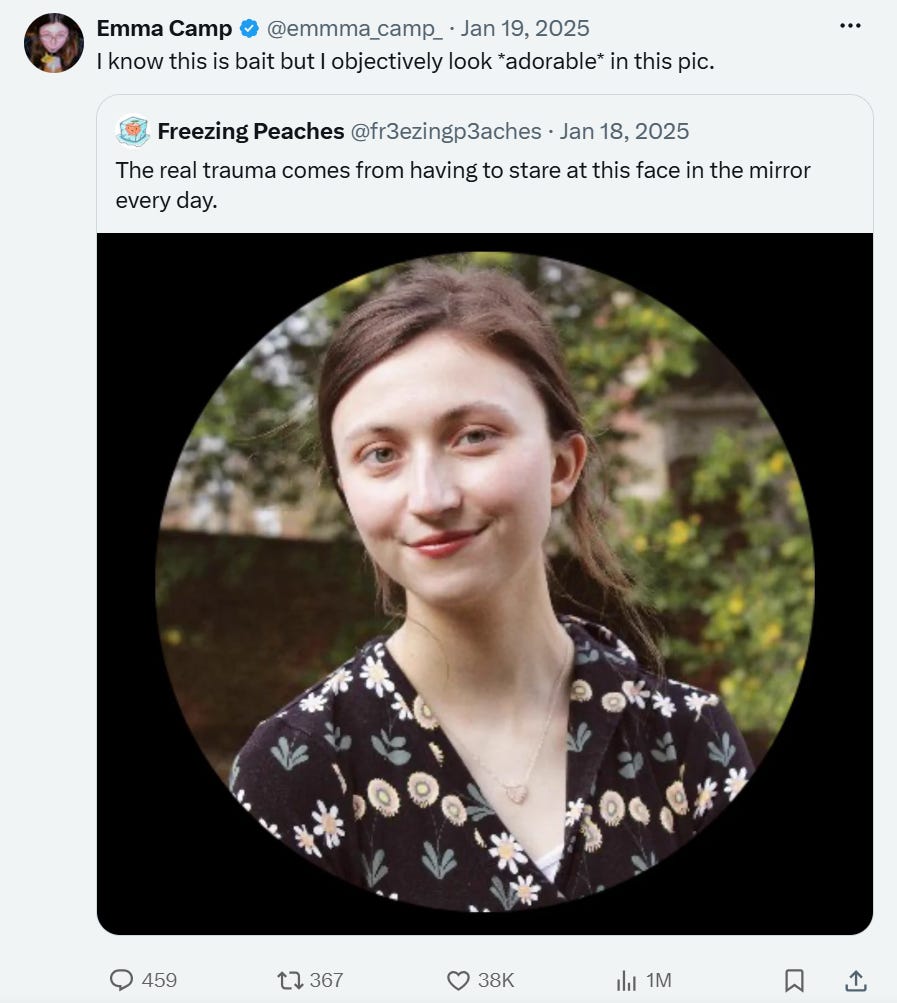
But she is not fazed. She knows she is not “everybody’s cup of tea,” and she is okay with that. You may find Camp’s aggressive recruitment off-putting. You may not want her to hand you a “Goodnight Mr. Jefferson” and then stare expectantly as you take your first sip. You may just want to pop down to the bar to watch the world cup game.
And that’s okay.
But if you would be interested, Camp’s going to make sure you get invited.
“You risk nothing. Nothing, nothing, nothing.” - Riggan Thomson, Birdman.
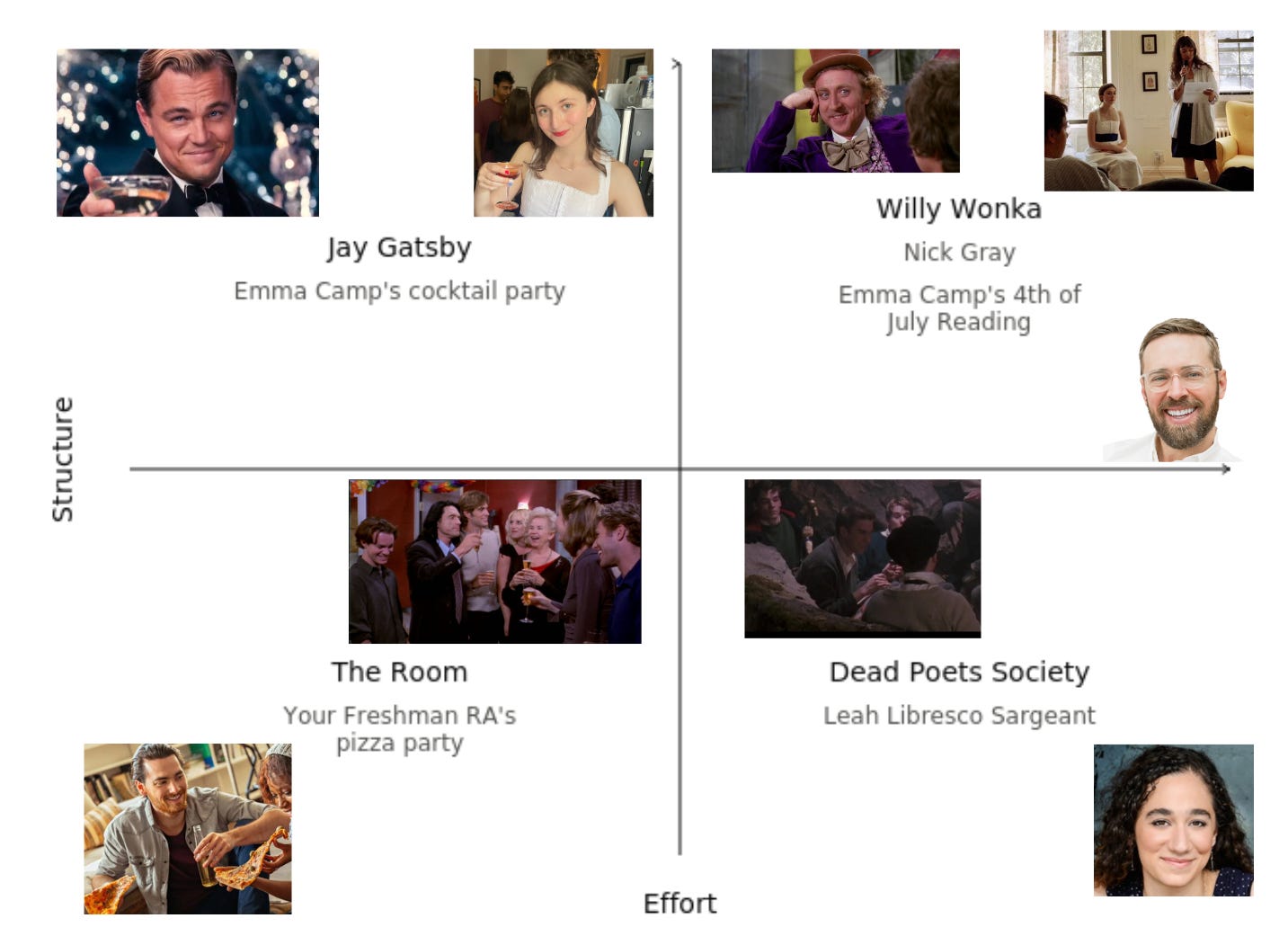
I think of hosts as falling along two axes: structure and effort. Effort is when Camp clarifies her lemon juice or Gray texts each invitee personally. It’s the front-end time investment.
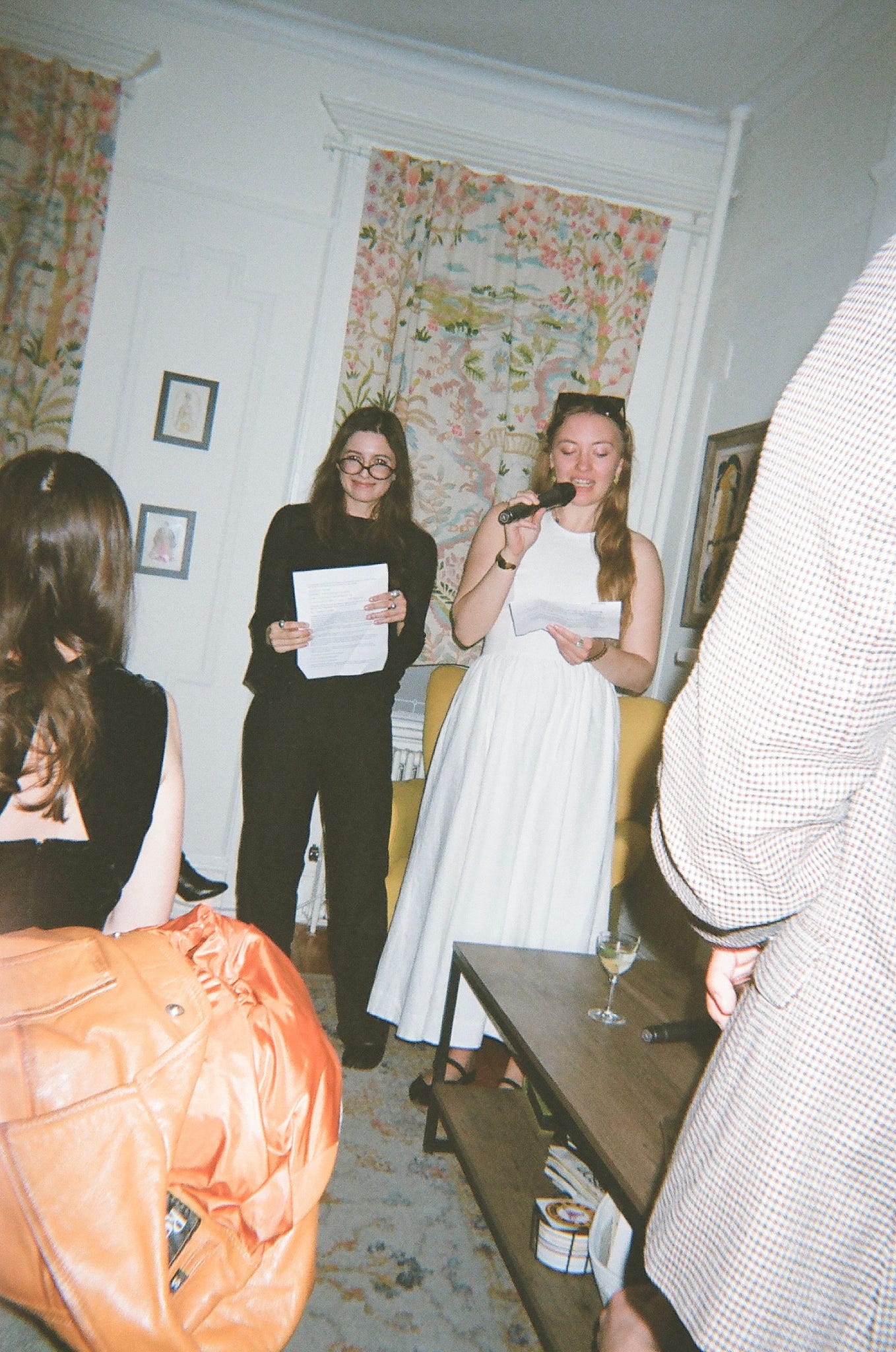
Structure is the format of the event itself. So Sargeant might serve watermelon and popcorn (low effort) for a Dorothy Sayers reading (high structure). Camp’s 4th of July reading featured five signature cocktails (high effort) with a half hour of prepared readings from Audrey Horne et al. (high structure). On other nights, Camp serves her signature cocktails but just has 60 people over to mingle (high effort, low structure).
I’ve created an infographic for how I think about the options and the famous examples:
Gray admits that you have to be a little cringe to add structure and activities to your party—like wearing name tags and having ice-breakers to introduce the group—but he is told time and again, “That was different, but it actually was really helpful, and I met a lot of new people.”
In other words, a cringe hosts allows everyone else to be cool guests. When you put yourself out there a bit, you give people something to talk about, something to connect over, or maybe just a brief respite to enjoy a prepared reading.
Gray says that with all the hosts who gave up during COVID, a new generation needs to pick up the mantle. Camp fears young people’s risk-aversion will keep them shut in—breaking from the herd is intimidating—but theater kids, as always, point the way.
They are used to being told their core commitment is frivolous and unimportant, just like hosting a party isn’t a big deal in the world’s eyes. At the same time, they know that art and human connection offer some of the greatest joys in life. As Fyodor Dostoevsky wrote, “Beauty will save the world.”
This dissonance can lead some hosts and theater kids to become a bit defensive about how what they’re doing MATTERS, and they end up acting like Michael Keaton in Birdman confronting the New York Times theater critic.
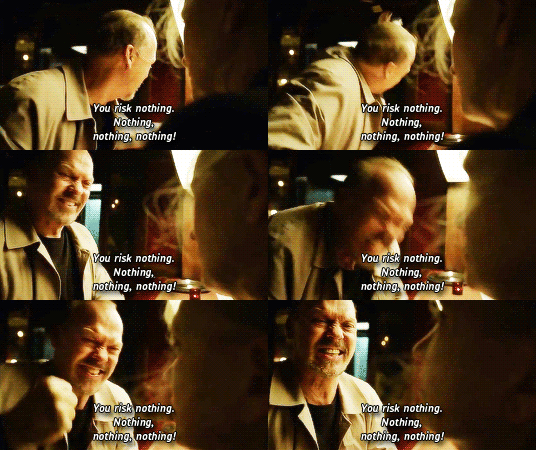
But the real artist understands that you must give yourself to the labor without demanding the fruits of it, and these hosts are no different.
If someone flakes on Sargeant, she asks how she can pray for them and finds there’s always something important going on. Camp admits that she gets ghosted plenty, but it’s still amazing to have 50 people come to your party. Gray asks prospective hosts to call him any time for impromptu coaching advice.
They have different reasons for hosting, different approaches to events, and different people they attract, but they all are motivated to bring people together and rage against the dying of the social life. The Times reported Grown-Up Theater Kids have run the world for some time now.
Perhaps they will save it too.
If you enjoyed this, you can find more of Camp’s work here:

And I would love to keep interviewing interesting people and writing about it, and this is the best way to help me do that:
If you’ve got hosting takes, leave them below! I find this topic fascinating.
I love that her last name is Camp. Coincidence or did she change it to fit the profile? Fantastic and inspiring. I will be plotting my next hosting event in emulation.