

Why Zoomers Love the Prequels
Search your feelings. You know it to be true.

In 2015, Charlie Rose asked George Lucas what he wanted the first line of his obituary to be. Lucas replied, “I was a great Dad.” His first child was born in 1981, and he had taken time off between Return of the Jedi and The Phantom Menace to focus on his family. On his first day writing The Phantom Menace, we see him first taking his daughter to school and then admitting he was up all night with a sick kid. It’s clear that the prequels he wrote were shaped by becoming a father.
Jar-Jar is silly in precisely the way a father playing with his toddlers is silly. Even as a kid, I found Jar-Jar vaguely embarrassing but in a comforting way. Anakin’s iconic lines—from “Are you an angel” to “Now this is pod-racing” to the infamous “I don’t like sand”—don’t seem cringe to a child. In fact, I thought Anakin’s sand monologue was rather suave when I first heard it.
Through some mix of intuition, genius, and luck, Lucas managed to tell a story that cinematically and politically captured the mood of the next generation. When I recently rewatched the films, I couldn’t believe how much I enjoyed them, and in my anecdotal research, my peers feel the same.
Part of that is obviously nostalgia, but the films feel strangely prescient as well.
Lucas said he wanted the prequels to explore the Republic in its final days and how it became the Empire. That comes through in the visual similarities between the Jedi starships and the Empire’s star destroyers or the difference between Padme’s elaborate costumes and Leia’s monochromatic ones. But there’s also a philosophical difference.
In the prequels, we see a society where science and technology reign while the originals show a return to spirituality and mysticism.
So even though Anakin and Luke are both skilled pilots and powerful in the force, their use of it is dramatically different. Luke turns off his targeting computer so that he can use The Force to fire his torpedo down the exhaust port. Anakin destroys the Trade Federation battleship through his knack for machines and seemingly dumb luck. Luke was taught the force like a catechism. Anakin was blood-tested surreptitiously by Qui-Gon, only to find that his Midi-chlorian counts were “off the chart.”
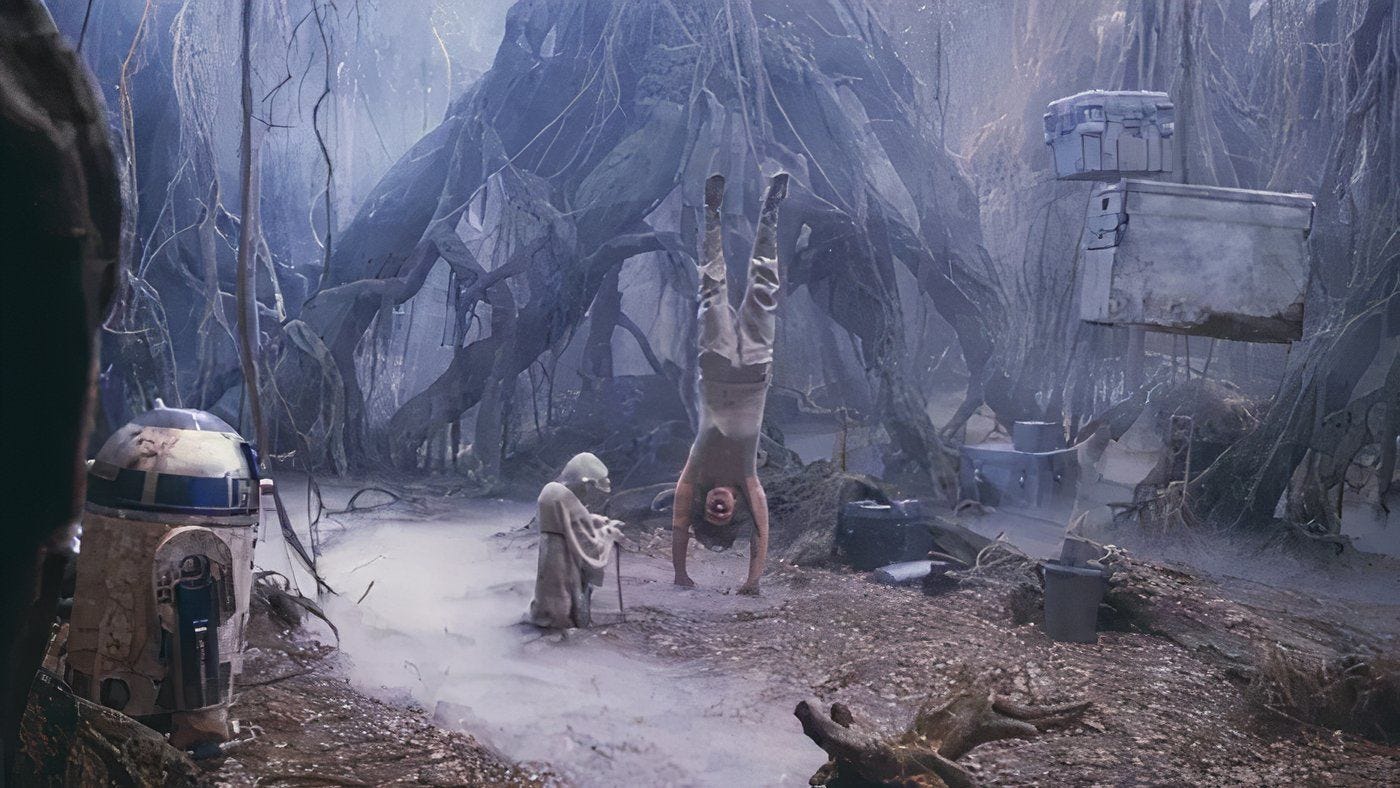
Consider which sounds more like our world today: doing handstands in the fog with Yoda or blood tests and frontier science granting God-like abilities?
Allow me to summarize the plot of the prequels using slightly more modern jargon. A young boy is recruited to fight for the Republic in a forever war. The goal of the war is unclear, and the only outcome appears to be consolidating power in the Chancellor. Upon returning home, the young man is torn between the democratically elected leader’s increasingly hegemonic power and a deep state of Jedi who seek to overthrow the executive and assume temporary control of the government. Deeply disillusioned, he ends up tearing everything down.
It’s not an allegory, but there’s plenty there for young people to connect with.
But Lucas is not a political filmmaker primarily, he’s concerned with the interpersonal drama and the choices of individuals. Despite Anakin’s many complaints about politicians, his breaking point comes when Mace Windu betrays the Jedi code.
At the start of Revenge of the Sith, Anakin and Obi-Wan rescue Chancellor Palpatine from Count Dooku. Obi-Wan is knocked unconscious in the battle, but Anakin disarms and subdues Dooku. At the Chancellor’s urging, Anakin executes Dooku, but he immediately feels shame for not acting in “The Jedi Way.” The Chancellor assures him that Dooku was too dangerous to be left alive.
In the film’s climax, this same decision faces Mace Windu. Windu defeats Chancellor Palpatine, and Anakin runs in as Windu holds his lightsaber above the unarmed man. Windu says Palpatine is too dangerous to be left alive, and as he winds up to kill Palpatine, Anakin intervenes, ultimately leading to Windu’s death.
Anakin isn’t brought to the dark side because the Chancellor deceives him, as Obi-Wan says, but because the Chancellor tells him the whole thing’s rotten. And he’s right.
Mace Windu and the Jedi are planning to overthrow the democratically elected Chancellor and take control of the Senate. They are sending Anakin to spy on the Chancellor. And ultimately, they are willing to execute Palpatine without trial. So Anakin chooses cynicism over naivete and sides with the Sith, hoping to gain enough power to save Padmé.
His faith is broken by Windu, and from there he quickly moves to killing younglings and declaring, “I have brought peace, freedom, justice, and security to my new empire.” But it’s clear his political philosophy is driven by hatred for the Jedi and their betrayal rather than any positive vision of change.
In the same way, the politics of many young people are driven by out-group hatred and a sense that their elders, the ones who were supposed to be looking out for them, betrayed them. The New Yorker ran a piece about Groypers, and this paragraph has stuck with me:
For a successful young professional attending a political conference, G. said things like “We have literally nothing to live for—we’re ready to die” a lot. His life, he claimed, was hopelessly compromised by the indignities of the modern world. “You watch these videos of Europe or America in the eighteen-hundreds or early nineteen-hundreds, and it’s beautiful,” he said. “Everyone’s well dressed. There’s, like, a tenderness and an innocence to it, and I feel like we’ve all been robbed of our innocence. All our buildings are these hideous rectangles. We’ve watched hundreds of hours of hardcore porn before we ever had our first kiss. Why the f— did that happen? Do our G.O.P. leaders care?”
This seemingly successful man has dedicated a huge portion of his life to destroying the GOP for spiritual rather than political reasons. The loss of innocence he mentions is the same thing that drove Anakin over the edge.
If you think Revenge of the Sith is the best film of the three, it is only because The Phantom Menace is the “worst.” Its over-the-top silliness and childlike innocence prove to be the last gasp of a decadent society, and it makes the darkness that follows all the more disturbing.
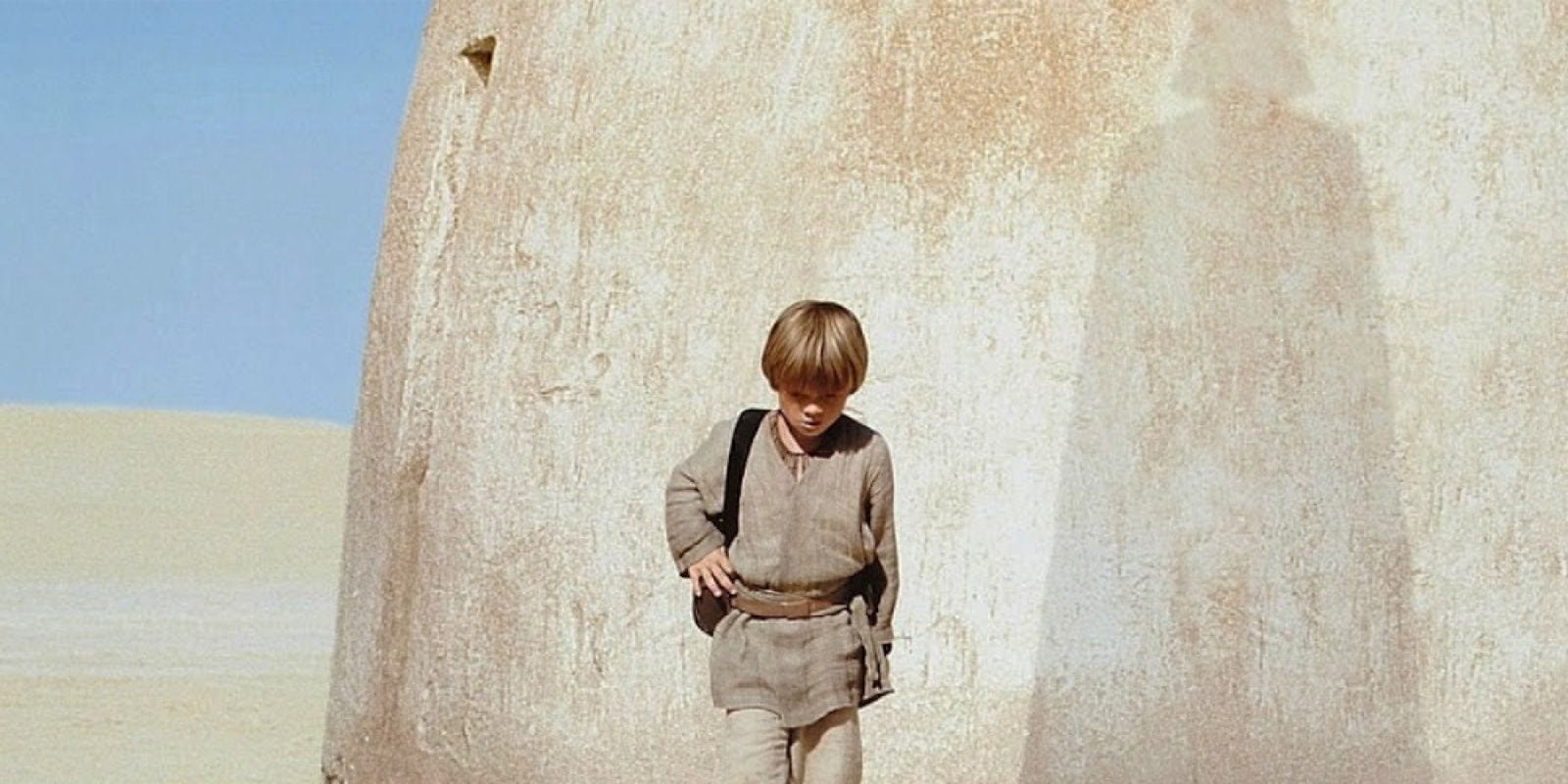
The boy who greeted his future wife with “Are you an angel?” ended up choking her and leaving her to die in childbirth. The kid who Obi-Wan raised to be “The Chosen One” ended up telling him, “I hate you” and leaving The Force in darkness. The boy whose Midi-chlorian counts were off the charts, who had the world before him, ended up destroying his friends, family, and legacy. It’s a tragedy that struck me harder this time than any past viewing.
I don’t believe we live in the Empire, but I do think the prequels were strangely prophetic in capturing the zeitgeist, and they’re worth re-watching if you haven’t recently.
Because political and cultural analysis aside, Geonosis still goes incredibly hard.
Attack of the Clones is not a good movie but man, did John Williams cook with the love theme and the arena theme.
my man