

The Mandalorian’s Aim is True
I have spoken.

David Foster Wallace wrote back in 1997 that “opening grosses and marketing strategies are now bigger news than the movies themselves [and] Cannes and Sundance have become nothing more than enterprise zones...the truth is that there’s no more real joy about it all anymore.”
This past week, we saw how little has changed in the past 30 years. Headlines reported, “AI takes over Cannes as agents privately seek big money deals” and “Pedro Pascal’s ‘The Mandalorian And Grogu’ Bombs At Box Office.” The big follow-up coming out of this weekend will be whether The Mandalorian and Grogu bounced back due to positive word-of-mouth or whether it cratered. I am predicting and praying it will be the former.
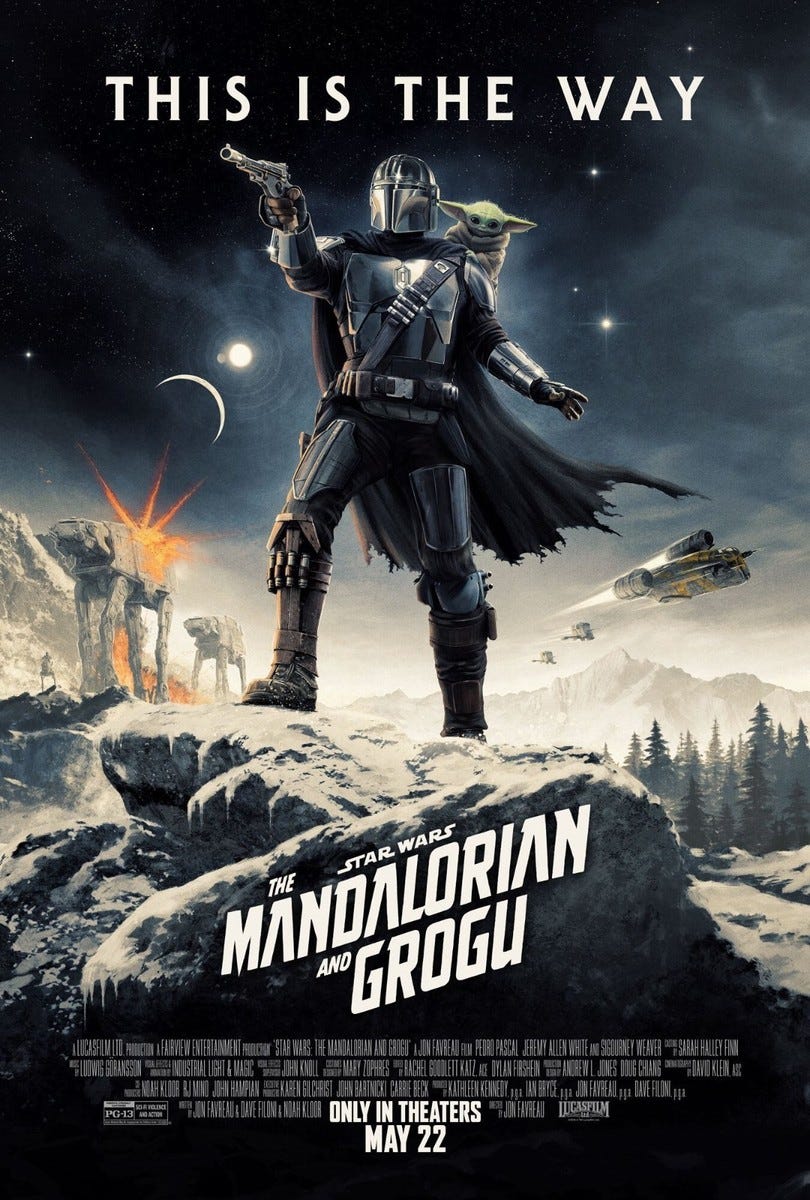
Critics are complaining that The Mandalorian and Grogu feels too episodic. There’s no singular villain the entire film builds toward, and there’s no set-up for a bigger conflict in the future. They say Jon Favreau wrote a script for season four of The Mandalorian, and then kinda reworked it to be a movie, but it’s really an abridged TV show.
My reply is, “Thank God.”
The Mandalorian is a show that’s always opted for self-contained episodes over sprawling narratives, and Favreau is staying true to what got them here. It’s refreshing to have a film that isn’t just a set-up for a sequel. You walk out of the theater with a sense of closure instead of a sinking feeling that your $15 ticket is now a sunk cost toward some sequel.
But it’s not just that.
When George Lucas was working on The Phantom Menace, he infamously said, “Jar-Jar is the key to all of this, if we get Jar-Jar working. Cause he’s a funnier character then we’ve ever had in any of the movies before.” And he was correct. Jar-Jar proved to be a lightning rod for critics, exemplifying the overreliance on CGI, tonal imbalances, and bizarre character choices in the film. He did not get Jar-Jar working.
In the case of The Mandalorian and Grogu, Grogu (or “Baby Yoda”) is the key to all of this because we’ve never had a character this cute before. We’ve never had a child this helpless, and that’s shaped the storytelling as well. Favreau has focused more on the Mando-Grogu relationship to propel the story than on the baddies.
There’s plenty of action, but at root, it’s a story about fathers, sons, and family. The key inciting incident for the original series is that Mando is asked to capture Baby Yoda and deliver him to Imperial forces. He fulfills his contract, but stricken by his conscience, he goes back and saves the child—sacrificing his credibility as a bounty hunter but finding an unexpected new life training Grogu and eventually joining The New Republic.
Of course, family stories are not new to Star Wars. George Lucas has called the sprawling story of the Skywalkers a “family soap opera,” but Baby Yoda is something new.
Watching as a father of young kids, I couldn’t help but be reminded of them. There’s the obvious stuff like the way Baby Yoda clings to Mando or crawls up under his arm to sleep. There’s his disobedience flipping switches on the ship or sneaking food. But there’s also the mutual dependence that develops.
At one point in the film, Mando is mortally wounded, but he tells Grogu to save himself and leave the planet. Instead, Grogu risks his life to stay and heal Mando. This is the only time Mando uses one of the show’s most famous lines: “The old protect the young. Then the young protect the old. This is the way.”
I imagine someone who has cared for an elderly parent would relate to that line literally, but I found it spiritually resonant as well. At first your newborn is dependent and you are caring for him. You need to watch out for his safety and explain how the world works. Over time though, you realize he is really the one helping you. He is shaving off your selfish edges, reminding you how amazing lawn mowers and motorcycles and airplanes are, expanding your heart in ways you did not realize were possible. This is the way.
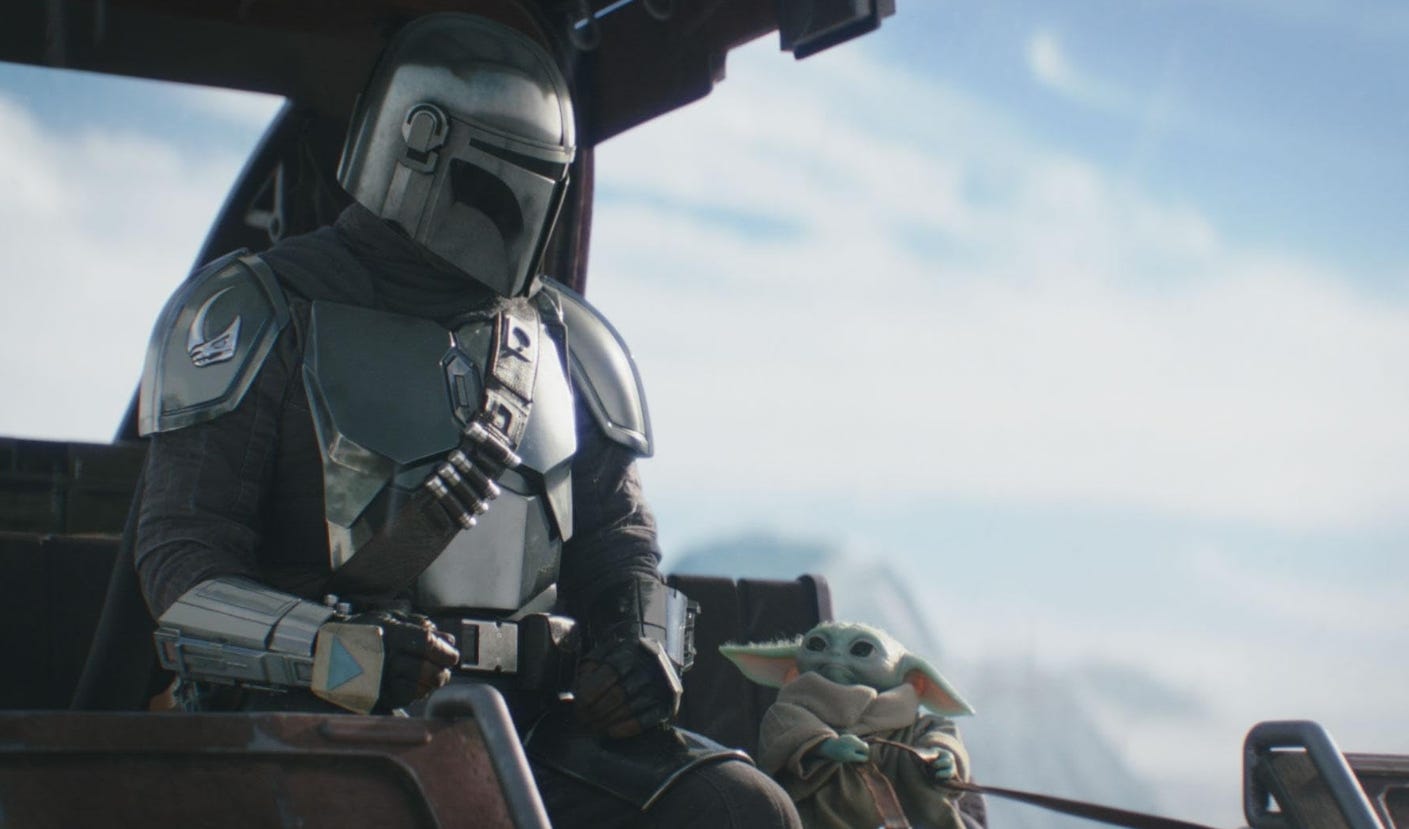
Because The Mandalorian and Grogu leans into these family relationships—including Rotta the Hutt, the son of Jabba the Hutt—the action doesn’t need to carry the whole film. It gets to just be entertainment. And it delivers.
You’ve got Rotta as a muscular Hutt fighting in a gladiator match. Then you’ve got Mando and Rotta facing off against a slew of monsters in a death match. (My friend noted that these are the same monsters from the board game in A New Hope). There was much ado about putting the stunt performers in the title card, but they deserve it. I enjoy watching Mando walk almost as much as I enjoy watching Tom Cruise run.
I recognize that I am the target audience of this flick many times over. It draws on Clone Wars lore, the most popular Star Wars show among Gen Z. I’m a parent of young children. I also am enough of a Star Wars geek to ponder how Boba Fett being a clone of Jango Fett impacts the father-son dynamic of the Fetts vis-à-vis Mando and Baby Yoda.
But I hope it can break out to a larger audience. I don’t want to live in a world where loving children is niche. I don’t want all the summer blockbusters to be meaningless action sequences setting up even bigger mindless crossover action sequences at a later date. I don’t want this to be the last I see of Mando and Grogu. But I know the money will ultimately do the talking.
Let’s see what it says this weekend.
Something shorter this week in case you want to catch the film over the weekend. Leave a comment if you’ve seen it and have opinions. More soon!
Due to the hype surrounding the launch of movies, I've always thought it would be nice to have a review site that was on different time scale. Say, a site that reviews movies that came out this month five years ago. It would evaluate the movie on pure entertainment value without the window dressing and shiny new object halo that disguise the movie's actual quality when it is launched. Or i guess i could just ask you what you think of it.
Everything you said here is 1000% true. It baffles me that this is not the most popular movie let’s come out in years. I haven’t felt as much joy watching a movie in so long.