

JD Vance's Conversion Isn't Cynical. It's Common.
His memoir tells a modern, archetypal conversion story

Alan Jacobs became a Christian to impress a girl.
He started with the book of Romans, and now 40 years later, he’s still married to that girl and is a renowned Christian intellectual to boot. He quipped, “People worry about their motives a lot. I don’t really worry about [that]. God doesn’t really care about your motives. He’s got bigger fish to fry.”
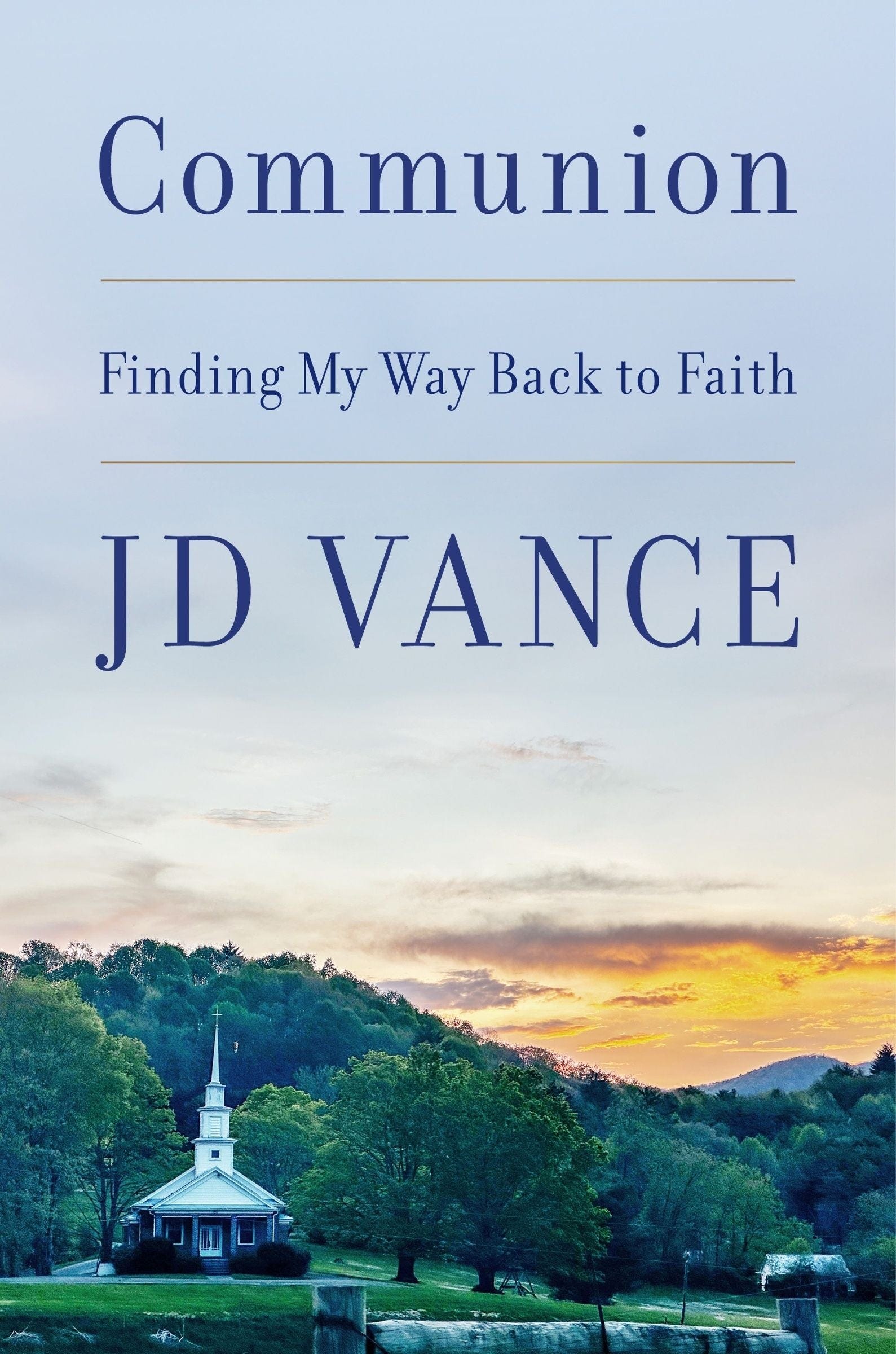
This question of motives came to mind reading JD Vance’s memoir Communion and the surrounding coverage. New York Magazine ran a piece about the DC “Young Catholic Elite Poised to Take Over MAGA,” and the author posited that Vance is “widely suspected, even among some on the Catholic right, of using religion for cynical, self-serving purposes.”
When Vance was asked in 2024 about his conversion, instead of talking about accepting Jesus as his Lord and Savior, he said he wanted to be a good husband, a good father, a good member of the community: “I thought the Christianity that I had discarded as a young man answered the questions about being a virtuous person better than the logic of the American meritocracy.”
By his own admission, he never had a “road to Damascus” moment, and many of the beats in his story don’t map onto the typical American conversion story. There’s no altar call, no tent revival. He didn’t see the light.
Rather than a religious awakening spurring social reform, he first observed the social and political breakdown around him and slowly worked his way back to Christianity. You can call that cynical or empty—just as many criticized Ayaan Hirsi Ali for converting because “Western civilisation is under threat”—but I read Vance as an archetypal modern convert.
He began the book 10 years ago, before he’d ever run for public office, and although there are some sections on specific policies, this book is less the memoir of a VP than the spiritual autobiography of a man who gained the whole world but lost his soul.
Vance is the first to admit that his life trajectory is unbelievable. He grew up in a dysfunctional family in rural Ohio and ended up at Yale Law School. His first book Hillbilly Elegy had such success that his Yale profs told him he had “more influence” than all of the faculty combined. A friend emailed Vance right after the book took off:
You don’t realize how lucky you are. Most people work their entire lives to get welcomed into these circles. I had to become an actual billionaire before I got invited to these billionaire conferences. For most people it takes thirty or forty years. You went from small town Ohio to dinners with Jeff Bezos in a few years.
Then Vance became Vice President at 40.
In a sense, you cannot win the meritocracy game any more than he has, but when he reflects on the breakout success of his book, he concludes, “I had won yet another elite competition, and I was gifted a job and lifestyle that many of my classmates envied. But I didn’t want that life any more than I wanted a Supreme Court clerkship.”
Vance self-identifies as a reformed striver, someone who was once obsessed with winning elite competitions merely to impress others, and throughout the book he mocks self-important professionals.
On the idea that parents should be praised for spending more time working and outsourcing childcare to boost GDP, he writes: “Only a bunch of elite graduates of Yale Law School and Harvard Business School could read about parents spending more time with their children and think, ‘But shouldn’t they be doing more productive things, like slaving away at an investment banking slide deck?’”
He contrasts the almost religious fervor that surrounds upper-class workaholism with his Papaw, a welder who provided for his family but kept his priorities straight. His working-class family gave Vance perspective on what really matters in life, and although many young converts will not have a story as dramatic as Vance’s, his dissatisfaction with the spiritual inheritance of careerism and consumerism is widely shared.
Many modern converts don’t start at “What must I do to be saved?” but instead, “Is this it?” And Vance’s unbelievable success gives him credibility to say, “You need Christianity, just like I did.”
In Robert Nisbet’s 1953 book The Quest for Community, he argues that the church and family’s vitality are linked to their social utility. When they cease to meaningfully offer “mutual aid, welfare, education, recreation, and economic production and distribution,” then they will struggle to “perform adequately [their] implicit psychological or symbolic functions in the life of the individual.”
The corollary is that as the state increasingly absorbs the functions of mutual aid, welfare, and economic distribution, people will look to it for spiritual fulfillment. This can express itself in the religious zeal of political activism, but it also can mean a closer integration of faith and politics, such as in the DC Catholic community.
Vance doesn’t advocate for a postliberal, integralist utopia, but he often looks to his faith to help make sense of political challenges. To explain his pro-worker labor policies, he cites Pope Leo XIII’s encyclical Rerum Novarum. When he admits his fear that “we inherited a great civilization and are slowly letting it fall into disrepair,” he quotes the line from Eastern Christian funerals, “memory eternal,” to say that we need to not only remember those who came before us but honor them by defending and carrying on their legacy.
He concludes that the West must assimilate new immigrants, and “one of the best institutions at taking people of different ethnicities and customs and forming bonds between them is church.”
He knows some people view this as “too instrumental,” but “if a set of beliefs is going to work, it must be both true and relevant.” Christianity is certainly relevant to many people today—Jordan Peterson can sell out theaters lecturing on Genesis—but the leap of faith remains a hurdle for converts like Vance.
Vance hardly mentions the role of prayer in his life, but I would guess many young people will recognize that struggle. Talking about Christianity as a civilizational bulwark can feel both more natural and more important than going to church or sitting down to read your Bible and pray. Modern man thinks in terms of influence and action and results—the ROI on prayer is fuzzy at best.
Thus, the verse that Vance returns to throughout the book is “you shall know them by their fruits.” On the one hand, that fits nicely with the Trump administration realpolitik talking points and Vance’s goal of becoming a virtuous husband and statesman. It is a pragmatic verse, one that you might expect from a boy who was let down by adults who promised they would change.
But it also points to how he found his way back to faith.
Leo Tolstoy analogized the spiritual life to a naked, hungry beggar, who was taken at the crossroads, given food and drink, and then asked to move some kind of handle up and down. If he moves the handle, he will find that it operates a pump that waters a garden, and then he will be given another job, “and he will gather fruits and will enter into the joy of his lord.”
The peasants do this without question, but Tolstoy writes:
[W]e, the wise, eat the master’s food without doing what he asks of us; instead of doing it we sit around in circles debating whether we should do something as stupid as moving a handle up and down. And then we think it over and decide that either the master is stupid, or that he does not exist and that we are the only intelligent ones. The only thing is, we feel that we are no good for anything and that we must somehow escape from ourselves.
When Vance was at Yale, he recognized that secular progressives “have their own religious zealotry. They just call it something else.” And ultimately, he found it unsatisfying to worship a Supreme Court clerkship or a bestselling book or even political power in Washington.
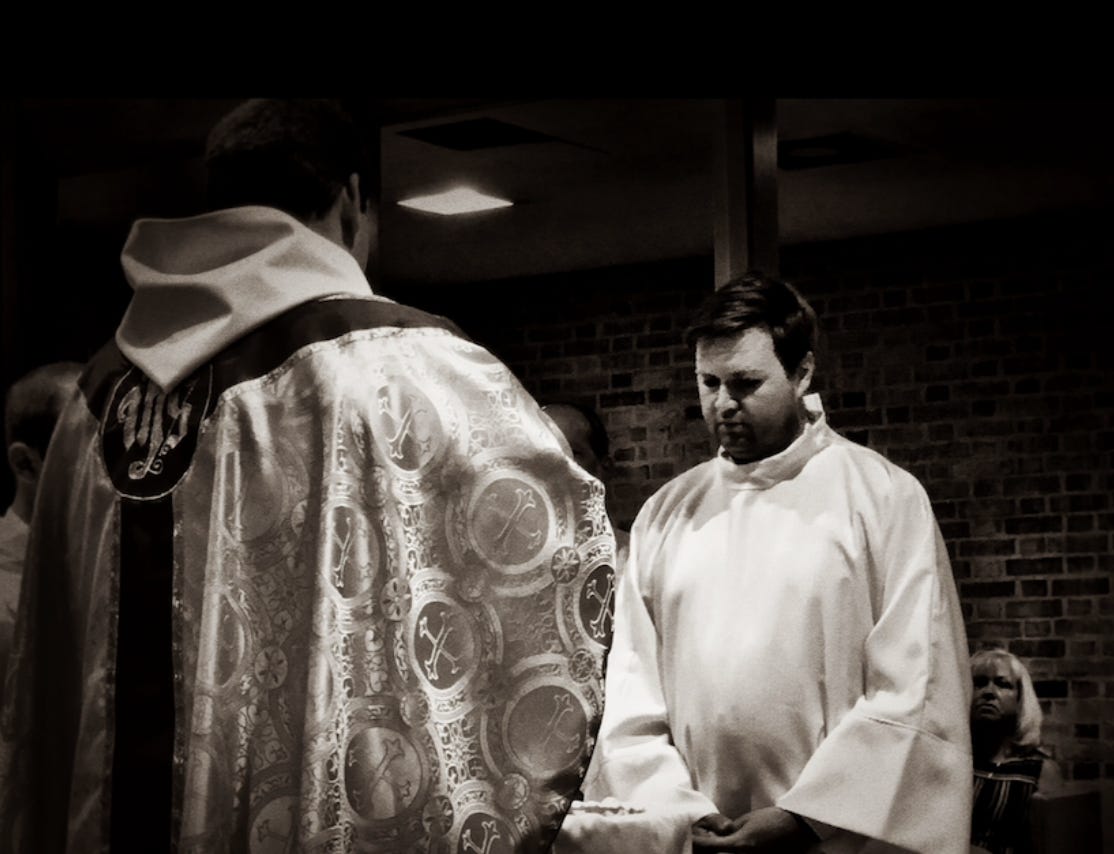
Instead, it was his wife Usha, who was “truer and purer and more just and lovelier than anyone” that put him on a different path. It was the faith and love of his Mamaw that called him back home. And he eventually realized that “there was a part of me—the best part of me–that took its cues from Catholicism.”
He knew Usha, Mamaw, and eventually Jesus by their fruits.
The critics think Vance has it all backwards. He starts with civilizational decay instead of Christ. He talks more about how Christianity is relevant than about whether it’s true. And should it really take Yale Law School, a bestselling book, and the Vice President’s office for you to realize there’s more to life than striving?
But Vance’s slow road to Rome reminds me of G.K. Chesterton, who wrote that in his quest to be original, “I only succeeded in inventing all by myself an inferior copy of the existing traditions of civilized religion…I am the man who with the utmost daring discovered what had been discovered before.”
There are no grandchildren of God, and each generation approaches God in their own way, with their own particular blind spots and their own particular strengths. By the standard of the Virgin Mary, who simply replied to the angel, “be it unto me according to thy word,” we all fall short of pure faith and devotion. Our motives are mixed.
But I personally would prefer a church with Alan Jacobs, the desperate lover, G.K. Chesterton, the thwarted heretic, and JD Vance, the reformed striver. Because if there’s no room for them in heaven, there’s certainly no room for me.
Thanks for reading this. If you enjoyed, feel free to leave a comment, and if you haven’t already, please consider subscribing! It really helps.